I will begin by bluntly stating the bad news, I was pickpocketed on a bus during my last day in Rome. Fortunately, the thief stole only my camera and not my wallet or passport. Unfortunately, all of my orginial photos from Venice, Pisa, and Rome are gone forever. I grimace to think that some grudgy twenty-something man looked over them with a criminal smile before deleting the whole lot. I had many photos of which I was particularly proud, especially those of the Vatican and the leaning tower in Pisa.
When I first noticed the camera was missing from my pocket I retraced all of my steps from the morning, searching around and asking various offices if anyone turned in a camera. Eventually I accepted the truth. The worst is that I'm fairly certain when and how it happened, and it could have easily been prevented.
I was on a bus and a young man came from the back of the bus and stood beside me. I even remember thinking it was unusual but I decided not to raise my guard. He leaned down as if to look at the window at a bus stop, and exited the bus at the next corner.
For all of the other days of the trip I have been extremely careful, having read again and again the dangers of pickpocketing. I have kept my valuables in front pockets with my hands inside, or in zipped jacket pockets. On the subway and around transit stops I have taken extra vigilance, holding my backpack in front of me, sitting when possible instead of standing, and observing my surroundings. On this bus ride however, I forgot all that.
I left my jacket pocket with the camera inside unzipped. Worse, my jacket was unzipped and I remained standing, so the pocket was hanging loose and easy to reach.
Now I can only learn from my mistakes. I refuse to allow this incident to repeat itself.
Incidentally, I bought a new camera the next day in Naples. The same model which I previously had, only twice the original price. A costly mistake to say the least.
With the bad news covered let's try to put behind us and move on to the more cheerful events of the past few days.
On the morning of my last day in Rome, before my camera was stolen, I visited the catacombs of Santa Sanbastiano Church outside of the city proper. This turned out to be the most interesting place for me to see in Rome. The church allows entrance to the underground tombs only with a guide, in my case one of the Brothers. There are three levels of tunnels, running 8 miles in total. The first earth removal began around 150 AD. Today the upper portion is accesible for visitors to see the creepy environment, but the bodies have been moved to the lower levels out of respect for the deceased. While these facts are interesting alone, the story behind these catacombs is even better.
Some of the first generations of Christians started work on these catacombs, and many others around Rome, as a place of worship and burial for their dead. At this point in time, 150 AD, Christianity was still illegal in Rome; therefore, churches and Christian cemetaries could not be located in the open. The early Christians secretly dug these tunnels underground in what was then the far countryside in which to lay their family to rest and worship. Today, the original tombs and altars remain. In order to pass through the maze of tunnels, the people used a system of early Christian symbols to guide themselves, so only they knew the proper way in or out. The complex grew overtime and came close to a Pagan necropolis (cemetary). The area around the necropolis collapsed a little time before 300 AD, forming a giant pit in the ground. The locals eventually named this area the necropolis of the catacombe, or the cemetary of the pit. From this we obtain the modern meaing for catacomb, an underground cemetary. However, the story for this site continues.
A family soon built their house over the pit, which they filled in with dirt. Modern archaeologists found the perimiter wall to this home, which one sees during a visit, and were perplexed by the amount of graffiti covering it. More so, the exact words of the graffiti, which were Peter and Paul. After further research and detective work this is the conclusion the archaeologists deduced.
A little after 300 AD the Roman emperor cracked down on the Christians in Rome. Fearing for the survival of their religious artifacts, the early Christians hid many of them around Rome. The remains of St. Peter and St. Paul were brought to this house for safe keeping. Christians in the know would come to this site and pray, leaving their prayers scribbled into the outer wall's plaster. When Christianity was accepted by Rome, the holy remains came to their present sites in Rome, but saints throughout the ages continued to visit these catacombs out of remembrance for their significance.
To think, I only thought I was going to see a bunch of old tunnels. I had no idea these catacombs would introduce me to such surprising history.
Later in the day I would visit a church in Rome which contains, according to tradition, pieces of the cross on which Jesus was crucified. Then I spent the rest of the day in a frantic and enraged state of mind of the loss of my camera, and travelling to Naples.
The next day I explored Naples while also searching for a new camera. At best, Naples is trashy and cheap; and at worst, it exists as a city edge of self-collapse. At one point while walking the streets I even questioned if I was still in Western Europe. I have never seen such quantities of litter and graffiti. Perhaps it was because I was a victim of crime the day before, but I could not feel calm walking the streets. If Rome is filled with energy, Naples is simply chaos. Of course, there is also this city's notorious reputaion with crime and the mafia. Put simply, this was probably not the best city for me to come to after being stolen from the day before.
In the afternoon I visited the ruins of Pompeii south of the city. The extant of which this Roman city existed, before volcanic ash covered, destroyed, and preserved it in 79 AD, amazed me. In many ways it was like a modern city. It possessed houses, offices, bakeries, theaters, brothels, and even a stadium. Many of the domestic frescos and mosaics remain intact. In fact, the frescos in the best preserved brothel display sexual positions used to advise clients. Authorities have moved most of the famous body casts to museums for further protection, but a few remain in Pompeii.
As the ash solidified around the citizens of Pompeii, their bodies slowly decayed and left behind cavaties in the rock. Later, archaeologists filled the cavaties with plaster, creating amazing statues of people in their final moment of life. The morbidly fascinating reality is that these are not statues created by an sculpter, rather the casts derive themselves from true human beings. A viewer can all to easily recognize a man covering his face in agony, or a women cowering in horror and fear. For this reason, I understand why many of the casts have been removed. If they remained, I think Pompeii would be too grusome of a site to visit with entire city's residents forever frozen in the state of dying.
At night I dined at Da Michele Pizzeria, one of the most famous pizzerias in Napoli, the birthplace of this world famous dish. I ordered the classic margheritta style, thin and covered in tomato sauce and mozzarella. Thanks to the Italians I befriended in Eichstaett, I remembered to look the part and eat it with fork and knife. While quite the tasty treat, I have to say that I still prefer the thicker American style pizza. Sorry Italy, you may have invented the pizza, but America perfected it.
That night I ventured to the top of a hill looking over the harbor of Naples. It's my first time in this city, but it was view I had seen over a hundred times before.
In my grandparents' bedroom, over their bed's headboard, hangs a painiting with nearly an identical night-time view of the scenic Naples harbor. When my father was young, he and my grandparents lived in the area of a Naples for a short period of time. As a small child during visits to my grandparents' house, I would sit on their bed and stare at the painting. I would wonder what life was like in Naples, Italy, and on the other side of the world. I imagined seeing it for myself for someday.
It was a surreal moment to finally find those shades of oil paint replaced with real twinkling city lights, the calm night-black water of the harbor, and the silhouette of the mountains in the background. A gripping reminder of how far I have come from that curious little boy to this world-travelling, yet ever still curious young man.
22 February 2007


18 February 2007
Roaming around Rome
Italy can keep Venice, give me Rome. This city amazes me like few others have. Its pulse of life never fades, rather it speeds along at a continuous beat. Perhaps this is what is really meant by the nickname for Rome, The Eternal City.
Before I get too deep into Rome, let me begin with my time after Venice. I left that watery city early in the morning. I walked a long confusing walk along its maze of streets to the train station in the morning darkness. Transfering at stations in Bologna and Florence, I eventually made my way to Pisa and walked off to its famous bell tower. I took an indirect route, away from the tourists and street hawkers. When I turned the corner and saw the tower with its distinictive lean I couldn't believe I was seeing it in person. I unbalancedly hiked up the tower's steps to the very top and took in the view. Walking on the top surface was a bit unsettling due to the tilt. After the tower I continued on to Rome.
Along the way I passed through some beautiful scenary. Along the right side of the train for part of the ride was the Tyrrhenian Sea. I saw many Italian villages and towns full of homes and buildings all the same characteristic shads of yellow, orange, and red. They reminded me of the many Mediterranean style vacation homes and condo developments I usually see every year in Florida. The only difference being that these buildings are real and authentic. When one taps on the exterior wall, he does not hear the hollow sound of fake stucco.
Wednesday night I arrived in Rome, and it immediately introduced me to its pazzo (crazy) lifestyle. The car traffic blows my mind; drivers whiz around the cars and buses on their scooters with seemingly no regard to others. In most of the crosswalks there are no walk/don't walk signs, the pedestrian must trust that the scooter barreling down on him will slow down or go around him.
Roma is a stunning city, full of one bella vista (beautiful view) after another. True, many of the buildings look past their prime, as in Venice, but the sheer number of monuments, ancient ruins, and civic art pieces nullifies all that.
Thursday I walked around the city center and took in the sights. I saw the Pantheon, one of the most important architectural wonders left behind by the ancient Romans. The dimensions of its dome are so peferct that it would be difficult, if not close to impossible, to replicate it even today. The center of the dome has a large hole in it to allow light in and remove some weight. It had rained earlier in the day and a puddle of water sat on the floor. As with many of the sights and attraction I have seen here, I previously learned and studied about the Pantheon; therefore, it was rewarding to finally see it with my own eyes.
In fact, that's becoming exhausting in a way. How many more times will or can buildings and pieces of art take me back and cause me to question if I am actually standing in front of them? While it Rome, that seems to never end.
Continuing with Thursday, at one point I saw a beautiful building guarded by decorated soldiers and decided to go inside it. I passed through security and didn't see much more to attract me, so I walked back outside. In this moment a fleet of police motorcycles and black diplomat escort cars pulled up in the front courtyard. In a flurry the motorcade drove through the building's car entrance as the soldiers saluted the passing cars. I asked a police officer who it was and he told me the Italian president, apparently I was in his house seconds before. Although, if my understanding of the Italian political system is correct, the President is more of a figurehead, while the Prime Minister is the main executive figure. I later saw the latter's house as well, and the Italian Parliament building. I also saw the famous Trevi Fountain later.
That evening I saw my first view of Vatican City, the world's smallest country and center of the Catholic Church, and St. Peter's Bascilica. Those minutes were some of the most emotionally charged in my life yet. Stunning. Beautiful. Magnificient. These words do not do the Bascilic justice. It truly inspires awe. The archiecture of the structure paired with the fact that it is the most important sight in all of Christiandom should make it a powerful sight for all. I did not plan to visit the Vatican until Friday, but after seeing it I simply couldn't resist.
I returned on Friday and spent the whole time touring the Bascilica and the Vatican Museums. I spent nearly two hours alone in the Sistine Chapel, in wonder of Michangelo's The Creation and The Last Judgement. The Chapel's floor space is probably a little larger than an NBA court, and yet this one room contains some of the most important artwork ever produced by mankind. The Chapel is also the sight where a new Pope is elected. In the Bascilica I gained a new understanding of what man is capable of building. A ten story building could fit inside the nave and not come close to scratching the ceiling. Inside the Bascilica are the remains of St. Peter, other holy relics, and art work like Michelangelo's sculpture The Pieta. I plan to return later tonight to walk up to the top of the dome for the view of Rome, and to attend Mass.
Yesterday I explored the Colosseum and the ancient ruins of the Roman Forum. These relics forced me to wonder what our current civilization will leave behind as our ruins. The Colosseum was impressive, but almost baren in the interior. I had no idea that so many ruins remained and one can walk so closely to them. I saw the site where the Roman senate met, Ceasar's tomb, the Temple of the Vestal Virgins, among many other important sites of ancient Rome. I often thanked Ms. Proffer of my senior year high school humainites class for teaching me about many of these attractions.
Tomorrow I will tour the Roman catacombs, something I've wanted to to do since reading a story set in this creepy location in the ninth grade. Then I will venture on to Naples, where I will attempt to find the house in which my father lived for sometime as a child.
I also must say that I love the food here. I thought I knew what gnoochi tasted like. I though I had eatten eggplant parmaegan. I was wrong. Dinner at Olive Graden will never be the same again. Buffala pizza is superb. I made the mistake of visiting the best gelati (Italian icecream) cafe in Rome on the first full day here. Now every other cup I buy tastes like McDonald's soft serve yogurt. At dinner i order a Fanta to drink and the waiter gave me a crazy look, apparently every dinner is usually accompanied by wine. I should have know better after spending time with Italian friends in Eichstaett. At least I remember to eat pizza with a fork and knife. Afterall, when in Rome, do as the Romans do.
I really enjoy Italy and will probably have to return someday. After this trip I will have seen all the sights that I must seen in Italy for my life, but there is so much more here to visit and do. The food is great. The history and culture is rich. The people are friendly (expect for those who try to rip you off by giving wrong change). In summation, I think I'm falling for Italy.
Before I get too deep into Rome, let me begin with my time after Venice. I left that watery city early in the morning. I walked a long confusing walk along its maze of streets to the train station in the morning darkness. Transfering at stations in Bologna and Florence, I eventually made my way to Pisa and walked off to its famous bell tower. I took an indirect route, away from the tourists and street hawkers. When I turned the corner and saw the tower with its distinictive lean I couldn't believe I was seeing it in person. I unbalancedly hiked up the tower's steps to the very top and took in the view. Walking on the top surface was a bit unsettling due to the tilt. After the tower I continued on to Rome.
Along the way I passed through some beautiful scenary. Along the right side of the train for part of the ride was the Tyrrhenian Sea. I saw many Italian villages and towns full of homes and buildings all the same characteristic shads of yellow, orange, and red. They reminded me of the many Mediterranean style vacation homes and condo developments I usually see every year in Florida. The only difference being that these buildings are real and authentic. When one taps on the exterior wall, he does not hear the hollow sound of fake stucco.
Wednesday night I arrived in Rome, and it immediately introduced me to its pazzo (crazy) lifestyle. The car traffic blows my mind; drivers whiz around the cars and buses on their scooters with seemingly no regard to others. In most of the crosswalks there are no walk/don't walk signs, the pedestrian must trust that the scooter barreling down on him will slow down or go around him.
Roma is a stunning city, full of one bella vista (beautiful view) after another. True, many of the buildings look past their prime, as in Venice, but the sheer number of monuments, ancient ruins, and civic art pieces nullifies all that.
Thursday I walked around the city center and took in the sights. I saw the Pantheon, one of the most important architectural wonders left behind by the ancient Romans. The dimensions of its dome are so peferct that it would be difficult, if not close to impossible, to replicate it even today. The center of the dome has a large hole in it to allow light in and remove some weight. It had rained earlier in the day and a puddle of water sat on the floor. As with many of the sights and attraction I have seen here, I previously learned and studied about the Pantheon; therefore, it was rewarding to finally see it with my own eyes.
In fact, that's becoming exhausting in a way. How many more times will or can buildings and pieces of art take me back and cause me to question if I am actually standing in front of them? While it Rome, that seems to never end.
Continuing with Thursday, at one point I saw a beautiful building guarded by decorated soldiers and decided to go inside it. I passed through security and didn't see much more to attract me, so I walked back outside. In this moment a fleet of police motorcycles and black diplomat escort cars pulled up in the front courtyard. In a flurry the motorcade drove through the building's car entrance as the soldiers saluted the passing cars. I asked a police officer who it was and he told me the Italian president, apparently I was in his house seconds before. Although, if my understanding of the Italian political system is correct, the President is more of a figurehead, while the Prime Minister is the main executive figure. I later saw the latter's house as well, and the Italian Parliament building. I also saw the famous Trevi Fountain later.
That evening I saw my first view of Vatican City, the world's smallest country and center of the Catholic Church, and St. Peter's Bascilica. Those minutes were some of the most emotionally charged in my life yet. Stunning. Beautiful. Magnificient. These words do not do the Bascilic justice. It truly inspires awe. The archiecture of the structure paired with the fact that it is the most important sight in all of Christiandom should make it a powerful sight for all. I did not plan to visit the Vatican until Friday, but after seeing it I simply couldn't resist.
I returned on Friday and spent the whole time touring the Bascilica and the Vatican Museums. I spent nearly two hours alone in the Sistine Chapel, in wonder of Michangelo's The Creation and The Last Judgement. The Chapel's floor space is probably a little larger than an NBA court, and yet this one room contains some of the most important artwork ever produced by mankind. The Chapel is also the sight where a new Pope is elected. In the Bascilica I gained a new understanding of what man is capable of building. A ten story building could fit inside the nave and not come close to scratching the ceiling. Inside the Bascilica are the remains of St. Peter, other holy relics, and art work like Michelangelo's sculpture The Pieta. I plan to return later tonight to walk up to the top of the dome for the view of Rome, and to attend Mass.
Yesterday I explored the Colosseum and the ancient ruins of the Roman Forum. These relics forced me to wonder what our current civilization will leave behind as our ruins. The Colosseum was impressive, but almost baren in the interior. I had no idea that so many ruins remained and one can walk so closely to them. I saw the site where the Roman senate met, Ceasar's tomb, the Temple of the Vestal Virgins, among many other important sites of ancient Rome. I often thanked Ms. Proffer of my senior year high school humainites class for teaching me about many of these attractions.
Tomorrow I will tour the Roman catacombs, something I've wanted to to do since reading a story set in this creepy location in the ninth grade. Then I will venture on to Naples, where I will attempt to find the house in which my father lived for sometime as a child.
I also must say that I love the food here. I thought I knew what gnoochi tasted like. I though I had eatten eggplant parmaegan. I was wrong. Dinner at Olive Graden will never be the same again. Buffala pizza is superb. I made the mistake of visiting the best gelati (Italian icecream) cafe in Rome on the first full day here. Now every other cup I buy tastes like McDonald's soft serve yogurt. At dinner i order a Fanta to drink and the waiter gave me a crazy look, apparently every dinner is usually accompanied by wine. I should have know better after spending time with Italian friends in Eichstaett. At least I remember to eat pizza with a fork and knife. Afterall, when in Rome, do as the Romans do.
I really enjoy Italy and will probably have to return someday. After this trip I will have seen all the sights that I must seen in Italy for my life, but there is so much more here to visit and do. The food is great. The history and culture is rich. The people are friendly (expect for those who try to rip you off by giving wrong change). In summation, I think I'm falling for Italy.
13 February 2007
Com' è bello!
I'm currently in Venezia, Italia, a.k.a. Venice, Italy. I'm also on the clock in an internet cafe, so this is will be short and sweet.
To the point, Venice dispoints me slightly. I think people have built up too much hype about it. From a distance the cityscape is beautiful, but up close all of the small faults add up. She may be the Queen of the Seas, but she past her prime in my opinion. It reminds me of the French Quarter in New Orleans, obviously breathtaking at one point in it's history and now a faded image of what once was. For another thing, I discovered there's not too much to actually do here. I shorted my hostel reservation from four to three nights because of this.
However, in spite of all of this the city is still worth a visit. The atmosphere is incredibly unique and mesmerizing. To top if off, it's Carneval season right now, the party time before Lent begins. The streets are full of people decked out in rich costumes and masks. At some points I feel as if Casanova himself may be concealed under one such mask. I took in Saint Mark's Square and Basilica, which houses his tomb. It was powerful to see the tomb and realize what one would find inside. I rode a gondola, but the cheap kind that only acts like a ferry across the Grand Canal. That cost 50 cents, the alternative of the tour version would cost around $90. I visited some other islands off of Venice: Burano (Venetian glass), Murano (Venetian lace), and Torcello (abandoned centuries ago due to malaria).
Italy easily keeps me entertained and happy. I like the fact that when I walk leave a store I can say ciao, and it's not spoken in fun. It simply sounds cooler than hello or good-bye. Italy is of course the center of fashion, and the Italians prove it without hesitation. No simple t-shirt and sneaker wearing twenty-somethings around Venice. Apparently the latest fade is wearing black jackets with a patch on the shoulder that says "Arctic Exploration Museum" and with a little picture of Alaska. I also like the Italian language because the prounciations are so fun. I'm picking up simple words and phrases as I go along. It helps that Italian and Spanish are similar, and that I finished a semester of studying the latter only five days ago.
I head to Rome tomorrow via a short stop in Pisa. As long as I see an Italian driving a scooter while wearing sunglasses I should have a good time. If he happens to say ciao to his friend before sputtering off down the street, it will be all the better.
To the point, Venice dispoints me slightly. I think people have built up too much hype about it. From a distance the cityscape is beautiful, but up close all of the small faults add up. She may be the Queen of the Seas, but she past her prime in my opinion. It reminds me of the French Quarter in New Orleans, obviously breathtaking at one point in it's history and now a faded image of what once was. For another thing, I discovered there's not too much to actually do here. I shorted my hostel reservation from four to three nights because of this.
However, in spite of all of this the city is still worth a visit. The atmosphere is incredibly unique and mesmerizing. To top if off, it's Carneval season right now, the party time before Lent begins. The streets are full of people decked out in rich costumes and masks. At some points I feel as if Casanova himself may be concealed under one such mask. I took in Saint Mark's Square and Basilica, which houses his tomb. It was powerful to see the tomb and realize what one would find inside. I rode a gondola, but the cheap kind that only acts like a ferry across the Grand Canal. That cost 50 cents, the alternative of the tour version would cost around $90. I visited some other islands off of Venice: Burano (Venetian glass), Murano (Venetian lace), and Torcello (abandoned centuries ago due to malaria).
Italy easily keeps me entertained and happy. I like the fact that when I walk leave a store I can say ciao, and it's not spoken in fun. It simply sounds cooler than hello or good-bye. Italy is of course the center of fashion, and the Italians prove it without hesitation. No simple t-shirt and sneaker wearing twenty-somethings around Venice. Apparently the latest fade is wearing black jackets with a patch on the shoulder that says "Arctic Exploration Museum" and with a little picture of Alaska. I also like the Italian language because the prounciations are so fun. I'm picking up simple words and phrases as I go along. It helps that Italian and Spanish are similar, and that I finished a semester of studying the latter only five days ago.
I head to Rome tomorrow via a short stop in Pisa. As long as I see an Italian driving a scooter while wearing sunglasses I should have a good time. If he happens to say ciao to his friend before sputtering off down the street, it will be all the better.
07 February 2007
My European Odyssey
With the completion of today's Geography exam all that remains is Spanish, then the semester will reach its end and lie in the past. In the last week or so whenever I wasn’t studying, I spent my time at a number of goodbye parties and dinners for the multitude of foreign students who will not return for the Summer semester. I have plans to see some again before I cross the Atlantic back to America, and with others the promise that if I ever visit their respective home countries, or they mine, a comfortable bed and warm meal await. From this one semester alone I made friends from more than 10 countries; the number probably doubles when you count all of the people with whom I simply spoke once or twice. While the past four months unquestionably justified and satisfied my decision to study abroad, they also exceeded my original expectations. I feel fortunate, no, blessed about the fact that I took that initial blind leap to commit to the full year. Were these the final days of my life in
Most of the friends about whom I have written or of whom you have seen pictures, will be gone by April 16, the first day of classes for the next semester. The French girls Amelie and Nawell, the first other foreign students I befriended, returned to
Yet with sad ending, comes a bright beginning, one over a year in the making. Saturday evening my European Odyssey commences. For the past two years, even when the notion of studying abroad was but only that, a notion, I have patiently and carefully saved my money for an ambitious dream. I earmarked the vast majority of every dollar I received, rather from pay check or birthday card, for a grand adventure. As the puzzle pieces fell into place, the picture became clearer. My grand adventure could in fact be a portion of an even larger one, studying abroad. As I saw it, it was indeed, for lack of a better word, perfect. The semester break in
My plans are as basic as the can be. It is more accurate to say that I have mere destinations in mind; perhaps I will see them all, perhaps I will see more. History shows me that when I rush to meet reservations during a trip, I usually miss out on something. Therefore, except for the hostel at my first destination, I have no reservations for accommodation or travel. My mind will not worry about the future, rather it will remain focused on where should it should be during travel, the present. My plans are also laid back in a such a way that if I fall in love with one destination I will gladly opt to stay a little longer, instead of hurrying off to the next city. I realize that such easy going plans present a bit of risk, but I believe they will benefit more than hinder me.
Now, I ask you to dust off your globe or pull that atlas off the shelf and trace my Odyssey with me. Keep in mind that this is only a ‘perfect’ scenario. As stated I may decide to stay at one place longer than originally thought, and will therefore scratch other destinations off the list. Likewise, a once in a lifetime opportunity may present itself to me and I could journey to an unconsidered locale, again forcing me to rethink my greater route. With that said, let the tracing begin.
Saturday night I board in a train in
If it’s a go with both, then I will begin venturing north by boarding a plane to
However, if I come to discover that time and that pesky problem of paying for things are not my friends, then I will take a more direct route toward
In France I will first arrive in Paris, but continue on my way to Angers, in western France and the Loire River Valley. In Angers I will meet up with two of my best friends from America, who arrived in the city several weeks ago to begin their studies for the semester at a local university. After a few days, the plan, as it stands now, is to take the train north to the Normandy coast and Mont-Saint-Michel, a fortress and village which together rest on a rocky outcropping from the sea floor. During high-tide this outcropping becomes an island, and during the other times it rises simply from a dry sandy plain. From here we will go together to the last destination of the Odyssey, Paris. The City of Lights requires no introduction. I would like to stay here for almost a week, before returning to Eichstaett on April 10 at the latest. My European Odyssey will end, and my second semester will begin.
I will attempt to post as often as I can in order to share the Odyssey with you, but possibly much time could pass between entries. If nothing else, check-in after April 10 and I should have a post with my favorite pictures and stories. Naturally, I presume I will return to Eichstaett with too many stories and photos to share them all, but I will surely share my most memorable.
I see Europe in my sights, and my finger eagerly rests on the trigger.
01 February 2007
The Semester Comes to a Close
I’ve been fairly busy recently, and with my final exams this week and next I assume it will remain that way. The problem with the German university system is that there are no other grades for a class than the final exam. This means, at least for me anyway, that everything will feel fine until the last few weeks before the exam, then the student will realize that he or she must hit the books. Although to put it like that is a bit of an understatement. It is far more accurate to say that the student must attack the bound pages of grammar, geography, and what have you with a fury and intensity similar to that displayed by a gorging lion pride. In the mean time, here’s a post mostly of photos from the last two weeks.
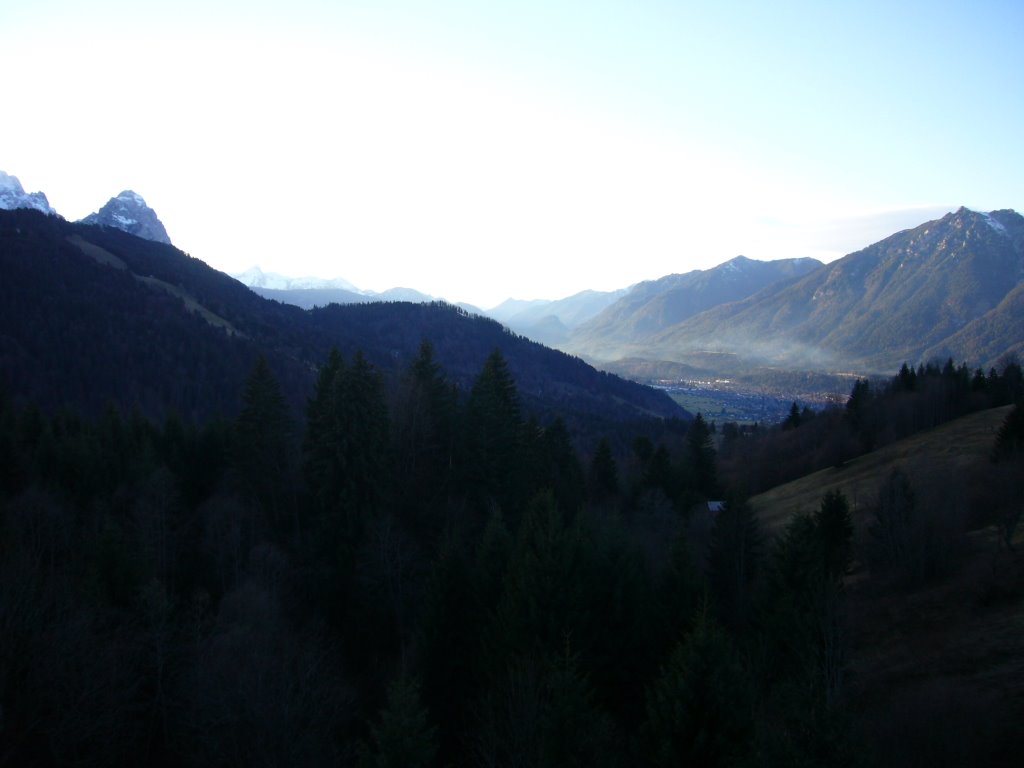
Two Saturdays ago I went with International Student Organization to the Alps in the cities of Garmisch and Patenkirchen. One finds these two towns about as far south in Germany as one can drive before entering Austria. Even here though the Alps only begin to rise from the continent. While not as tall and stunning as the Swiss or Austrian Alps, the scenery was nonetheless beautiful. However, you will notice the disappointing lack of snow in the photos. It felt more like a Spring day.

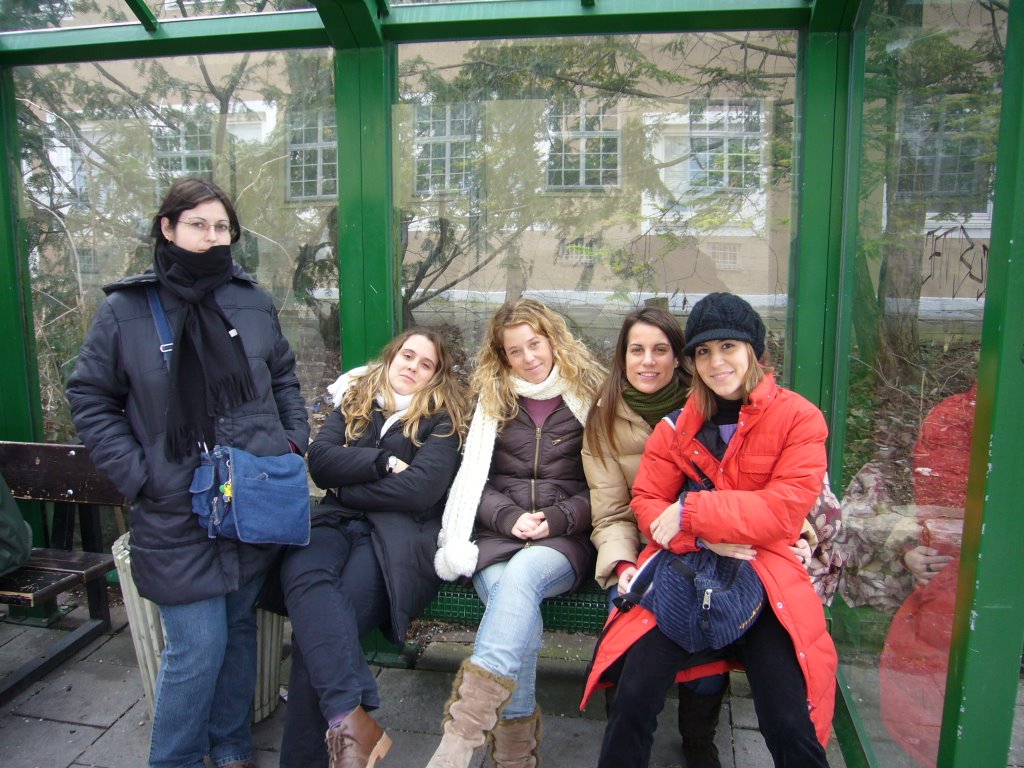
Here are all of the Spanish girls as we wait for our bus. From the left, Maria, Nawellia, Ellena, Angela, and Olga.

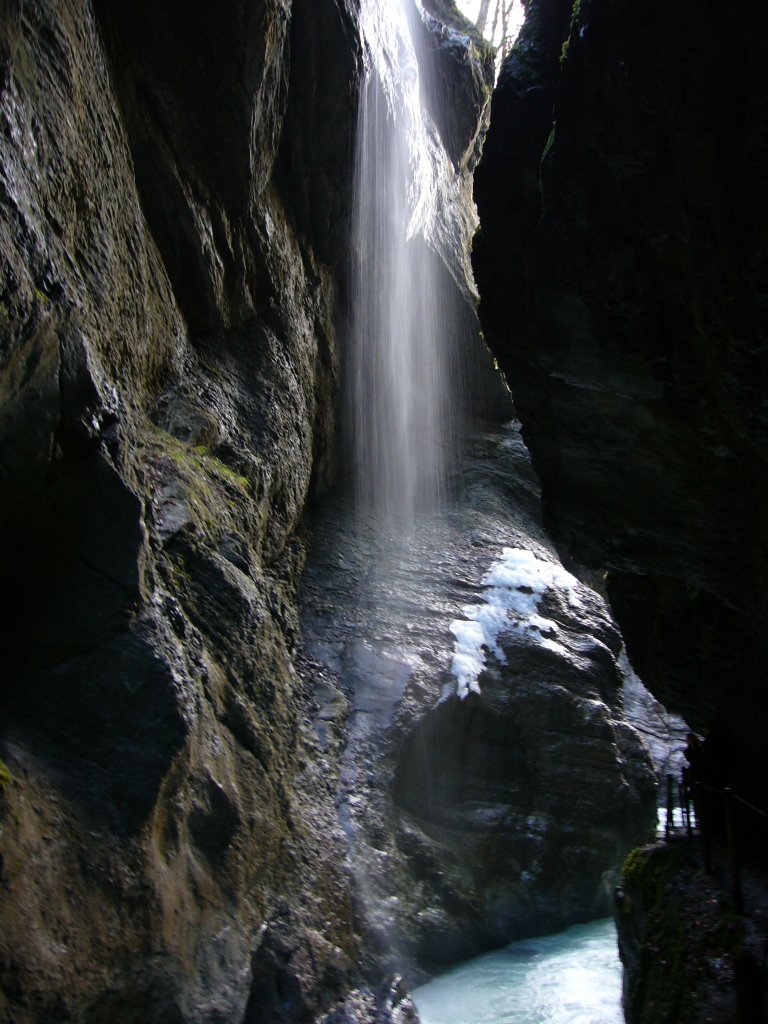
The first part of our day was spent hiking through a rock gorge worn over the millennia by the oh so patient yet persistent force of moving water.


Next we hiked up to the summit of one mountain which rose to around 3,800 feet above sea level. I don’t think the organizers of the excursion have a lot of hiking experience because they underestimated the group’s ability to ascend the trail in a timely manner. Looking around at the summit I think it was safe to say that most people were wondering what the planners were thinking. Of course many of the girls were also wearing stylish boots instead of good athletic shoes, I imagine that could have played a part in their misery. I on the other hand had a great time; the hiking made this my favorite excursion with the ISO.


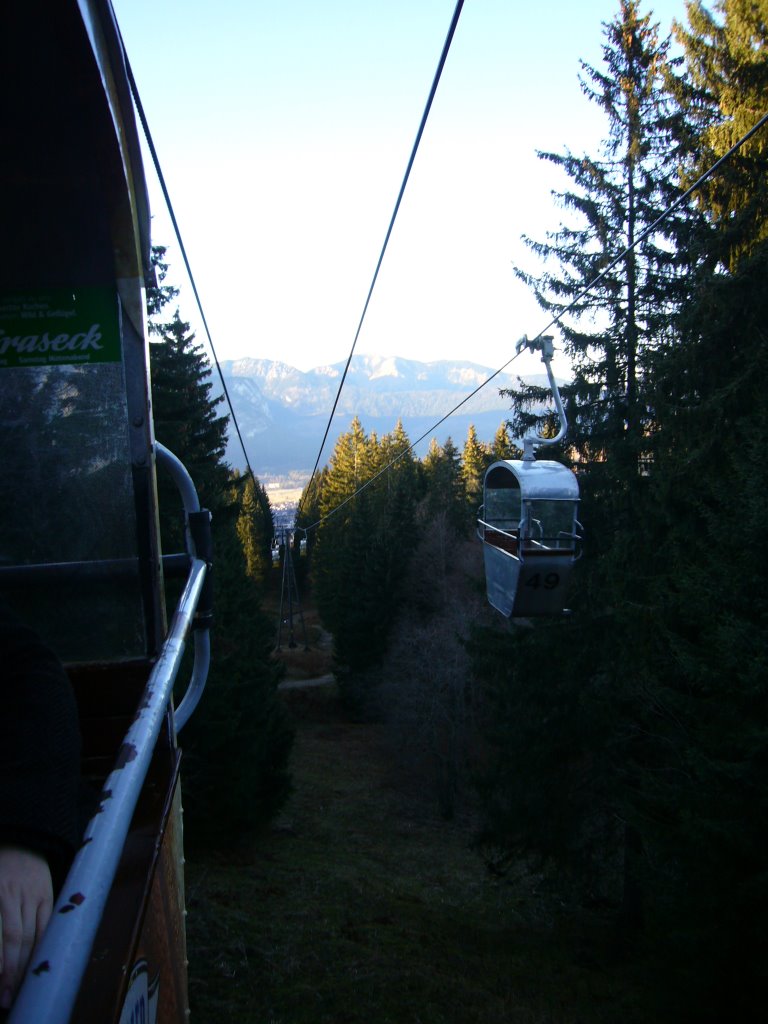
From the Summit we took a cable car back down to Garmisch. The Winter Olympics were held in the city a few times in the mid-1900s. Here are some views of the cable car and the ski jump stadium. Television greatly distorts the height and angle of these jump structures.


From the train station we could see the Zugspitze, Germany's tallest mountain at almost 10,000 feet. It's the peak the farthest to the right.

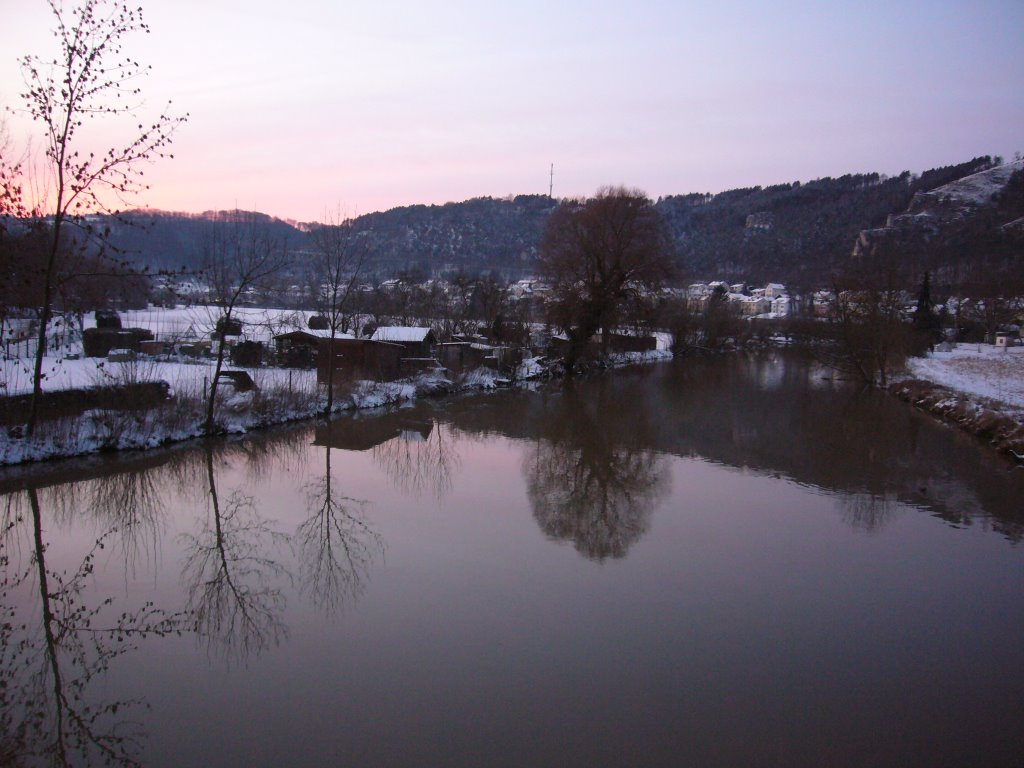
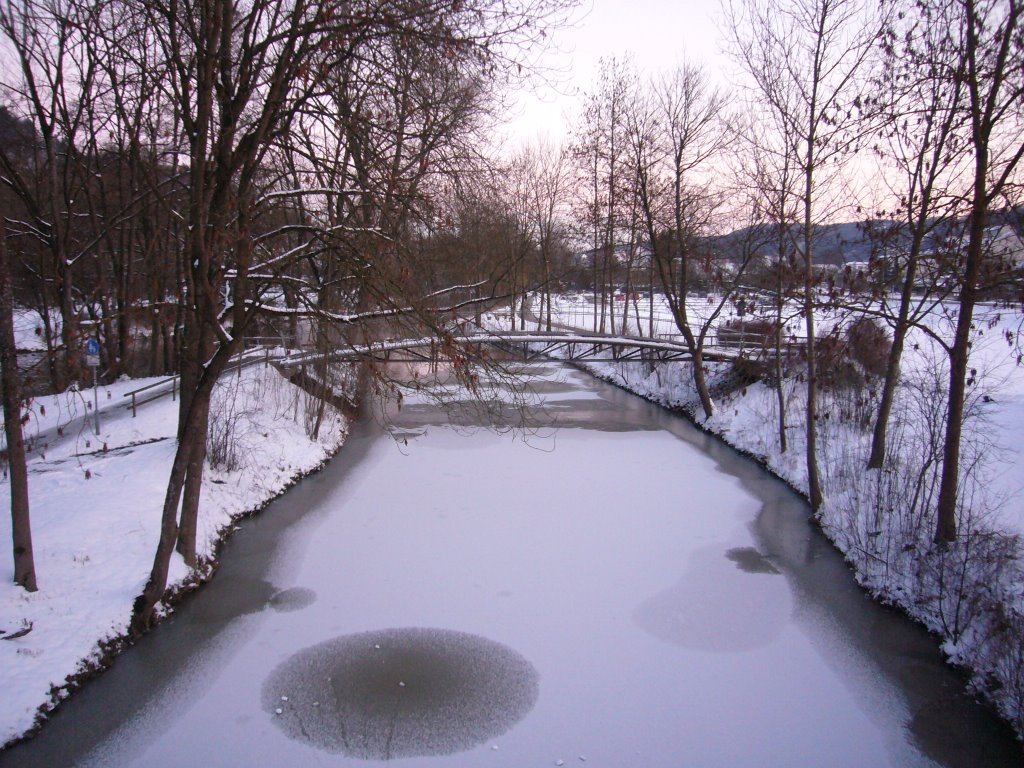
Last week the first Winter snow arrived in Eichstaett for the year, and remained around for nearly the whole week before the temperatures took an abrupt about face and rose above the freezing point.


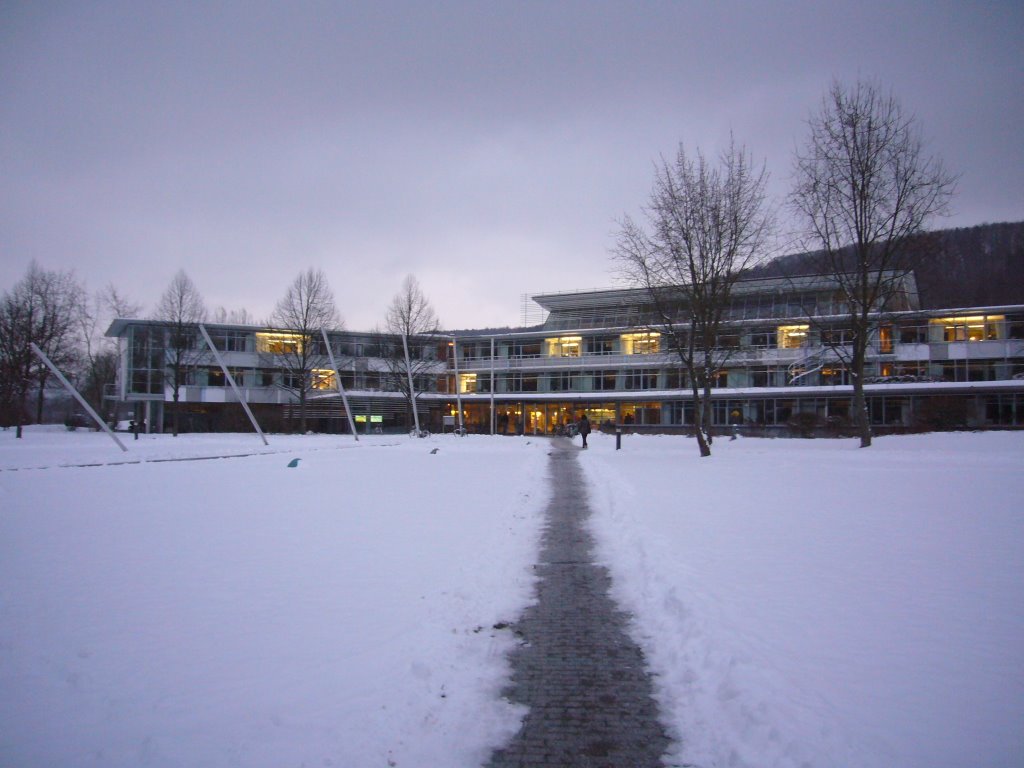
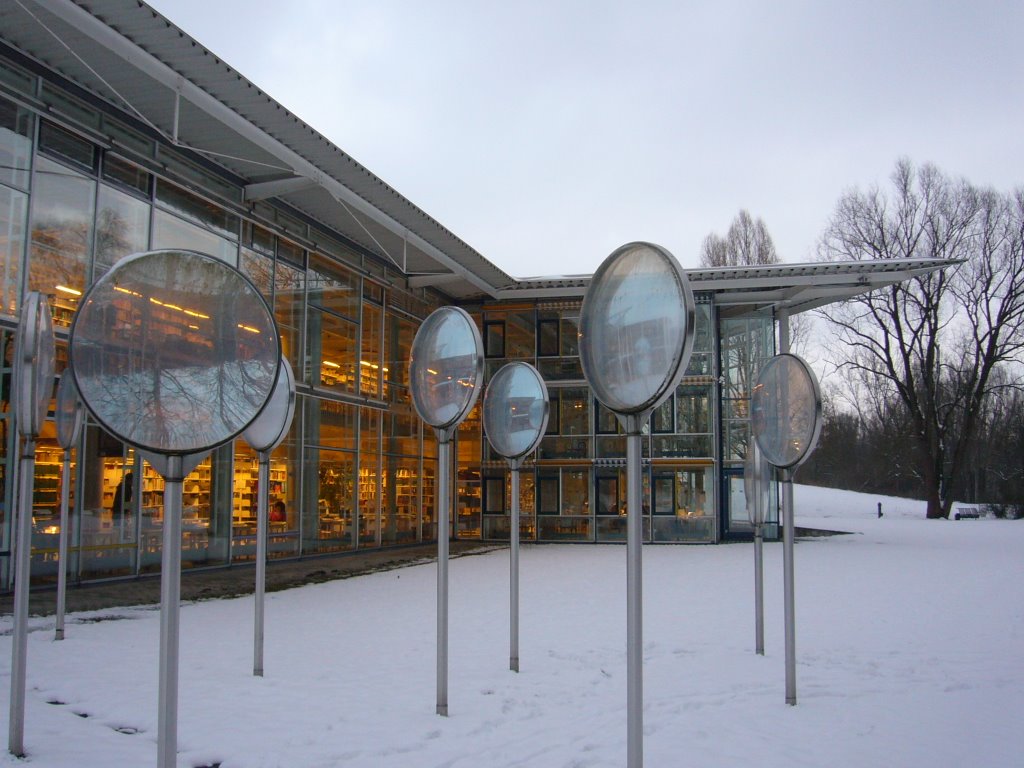
Here is the university's main library. It was desigend by architect Daniel Libeskind, who also designed the orignial redevelopment plans for the World Trade Center site in New York City.


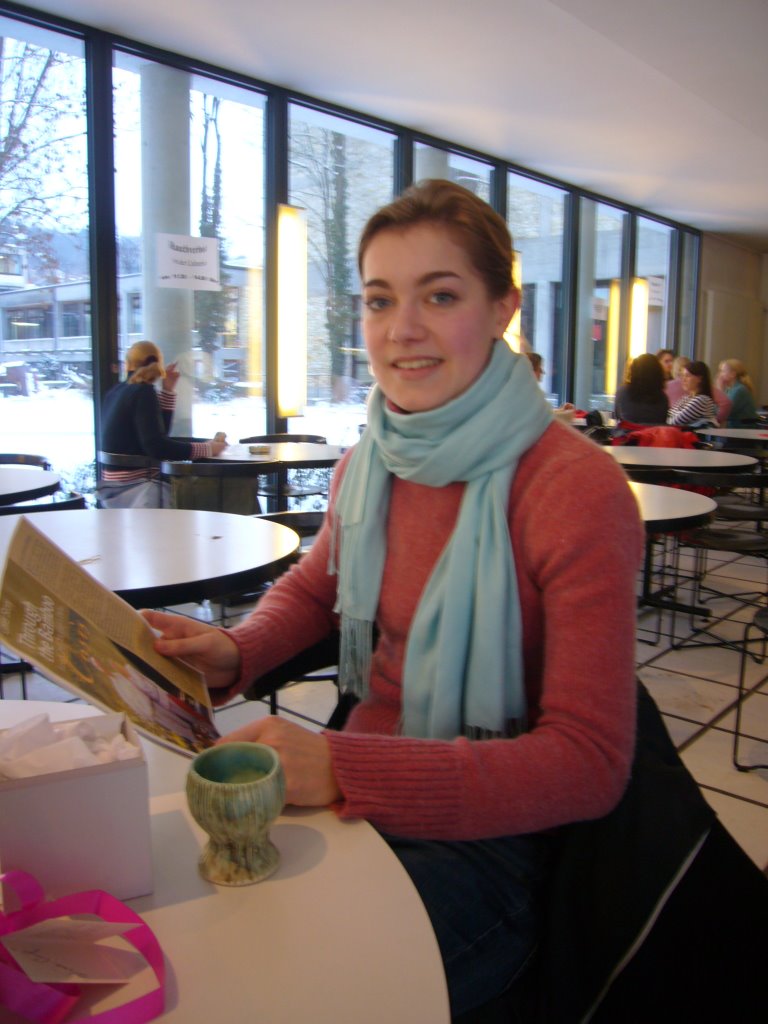
On Thursday I presented a belated Christmas gift to my university-appointed tutor, Charlotte. The gift, which my parents brought from America, was a piece of pottery molded by a pair of relatively famous artists in the area of Memphis, the McCarteys. She repeated over and over that a gift was unnecessary, but after the excellent help with which she provided me during my first days in Eichstaett I regarded such talk as nonsense.

This past Friday was Nawell’s last day in the Eichstaett before heading back to her university in France. A small goodbye party was held for her in the fourth floor kitchen of St. Mike’s dorm. The first photo is of the party’s honoree.

Here we have Amelie. I look at her and think French.

The same usually goes for Ester.


Sunday I made a good old typical American breakfast for Federica, Valleria, and Charlotte. The meal consisted of bacon, scrambled eggs, hashbrows, and blueberry pancakes. The maple syrup proved a tad difficult for me to track down in Eichstaett, but I eventually found some imported directly from Canada. When we sat down to eat Federica asked what were we supposed to eat first, I smiled and said everything together. One thing I’ve noticed about the European eating habits is that very different tastes, such as sweet and savory, are rarely enjoyed at the same time. Therefore, sugary blueberry pancakes covered in syrup with eggs and meat on the side seemed odd to the Italians. Charlotte, having lived in Vermont for a short period of her life, knew better what to expect out of the breakfast, and had tried each item before. However, each dish was new for the Italians, who seemed to enjoy it all down to the last morsel.
As of today I have only two exams remaining. Now that we’ve caught up, I must be returning to the lion’s den to continue my studies. Once I’ve completed the last multiple choice, you should expect a post about my upcoming travels, which I’m referring to as my European odyssey, and my plans for the next two months off from school.
Two Saturdays ago I went with International Student Organization to the Alps in the cities of Garmisch and Patenkirchen. One finds these two towns about as far south in Germany as one can drive before entering Austria. Even here though the Alps only begin to rise from the continent. While not as tall and stunning as the Swiss or Austrian Alps, the scenery was nonetheless beautiful. However, you will notice the disappointing lack of snow in the photos. It felt more like a Spring day.
Here are all of the Spanish girls as we wait for our bus. From the left, Maria, Nawellia, Ellena, Angela, and Olga.
The first part of our day was spent hiking through a rock gorge worn over the millennia by the oh so patient yet persistent force of moving water.

Next we hiked up to the summit of one mountain which rose to around 3,800 feet above sea level. I don’t think the organizers of the excursion have a lot of hiking experience because they underestimated the group’s ability to ascend the trail in a timely manner. Looking around at the summit I think it was safe to say that most people were wondering what the planners were thinking. Of course many of the girls were also wearing stylish boots instead of good athletic shoes, I imagine that could have played a part in their misery. I on the other hand had a great time; the hiking made this my favorite excursion with the ISO.


From the Summit we took a cable car back down to Garmisch. The Winter Olympics were held in the city a few times in the mid-1900s. Here are some views of the cable car and the ski jump stadium. Television greatly distorts the height and angle of these jump structures.

From the train station we could see the Zugspitze, Germany's tallest mountain at almost 10,000 feet. It's the peak the farthest to the right.

Last week the first Winter snow arrived in Eichstaett for the year, and remained around for nearly the whole week before the temperatures took an abrupt about face and rose above the freezing point.



Here is the university's main library. It was desigend by architect Daniel Libeskind, who also designed the orignial redevelopment plans for the World Trade Center site in New York City.
On Thursday I presented a belated Christmas gift to my university-appointed tutor, Charlotte. The gift, which my parents brought from America, was a piece of pottery molded by a pair of relatively famous artists in the area of Memphis, the McCarteys. She repeated over and over that a gift was unnecessary, but after the excellent help with which she provided me during my first days in Eichstaett I regarded such talk as nonsense.
This past Friday was Nawell’s last day in the Eichstaett before heading back to her university in France. A small goodbye party was held for her in the fourth floor kitchen of St. Mike’s dorm. The first photo is of the party’s honoree.
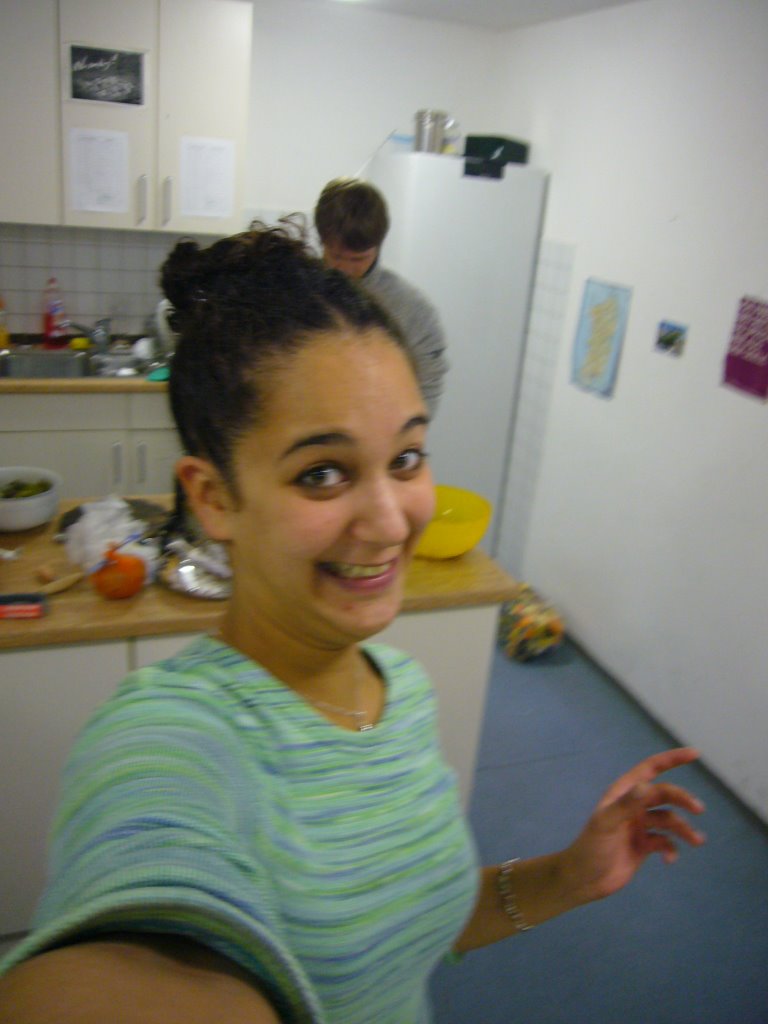
Here we have Amelie. I look at her and think French.

The same usually goes for Ester.


Sunday I made a good old typical American breakfast for Federica, Valleria, and Charlotte. The meal consisted of bacon, scrambled eggs, hashbrows, and blueberry pancakes. The maple syrup proved a tad difficult for me to track down in Eichstaett, but I eventually found some imported directly from Canada. When we sat down to eat Federica asked what were we supposed to eat first, I smiled and said everything together. One thing I’ve noticed about the European eating habits is that very different tastes, such as sweet and savory, are rarely enjoyed at the same time. Therefore, sugary blueberry pancakes covered in syrup with eggs and meat on the side seemed odd to the Italians. Charlotte, having lived in Vermont for a short period of her life, knew better what to expect out of the breakfast, and had tried each item before. However, each dish was new for the Italians, who seemed to enjoy it all down to the last morsel.
As of today I have only two exams remaining. Now that we’ve caught up, I must be returning to the lion’s den to continue my studies. Once I’ve completed the last multiple choice, you should expect a post about my upcoming travels, which I’m referring to as my European odyssey, and my plans for the next two months off from school.
Subscribe to:
Posts (Atom)