02 April 2010

Land of Ice and Fire

Iceland, a small island country that, in more ways than one, divides itself between Europe and North America. Its capital lies the closest to America of that of any European country, its people trace their heritage back to the Vikings, and yet the nation proudly boasts its stand-alone identity. Icelanders feel the forces tugging at them from both sides of the Atlantic, but they aren't pulled away from what they know as home. Instead, they work to ensure that their beguiling country can offer an energetic and culture-packed punch of its own. With enough time, money, and open-mindedness, a visitor could indeed by knocked out by this isolated country of the North.

As said, Iceland rises from the North Atlantic several hundred miles northwest of the United Kingdom and east of Greenland. Chances are, if you've flown between Europe and America, you've flown over this rocky island or close to it. Much can be said about the island's geothermal activity, but I'll save that for more appropriate places in the post. Suffice it to say for now that Iceland is one the Earth's most dramatic spots where one can witness the inner-workings of our planet breaking through at the surface. Barren, cold deserts and thick glaciers cover the interior of the country and create an environment where human settlements don't exist. The exterior of the island and its lowlands offer a more hospitable setting. Here, and especially in the southwest portion of country, warm water from the Caribbean meets Iceland courtesy of the Gulf Stream ocean current. This delivery system makes life in Iceland far more possible, warming the air and providing mild winters. Due to this, most of the nation's roughly 300,000 citizens live in this region of the country, and it is also Iceland's only agricultural area of significance. Although the country is not as cold as its name would lead one to believe--the temperatures actually remained above freezing in Reykjavik for the duration of my stay--it was nevertheless a challenging and distant land for the first Icelanders to settle.

Tales exist of solitude-seeking Irish monks being the first ones on Iceland, but the island's history of human habitation mostly starts with the Vikings. The so-called Era of Settlement began for Iceland in the early 10th century AD. Most of what we still know about this time in Iceland's history comes from the Viking sagas, written stories that documented life in the society. While Icelanders will try to tell you that the Vikings were not as bad as their reputation, based off of some the historical accounts I've learned I don't think I can agree with them entirely on that point; however, I do acknowledge that the Vikings were more than mere pillagers and pirates. Some of their other areas of expertise were exploration and settlement.

During their raids on foreign lands the Vikings also kept their eyes open for any suitable land that they could claim as their own. In time this would prove necessary, as coastal towns and villages in the rest of Europe eventually learned to anticipate the Vikings' attacks. Therefore, the Vikings branched out from Scandinavia with permanent settlements in northern Europe and the British Isles. The exact details of their arrival in Iceland remain unknown, but one tale says that a Viking leaving Norway was blown off course and came to Iceland, such a trip would have been no simple wrong turn. However the Vikings first discovered the island, they were fairly well settled into the 10th century. Incidentally, their westward settlement did not end at Iceland. From there the Vikings pushed on to Greenland and, even if only for a relatively short amount of time, North America.

When the first settlers arrived they were pleased to find what looked like a perfect new home. Virgin forests of sturdy trees covered the lowlands and hinted at what was surely fertile soil. Though land animals were few, the ocean provided a bounty of food and dozens of bird species nested on the shores. Best of all, there was not a soul on the island to protest the Vikings' arrival; it was free for the taking. The settlers proceeded to do what one would expect. They cut down trees for wood, and cleared swaths of forest for land to plow and land to graze for the farm animals, like cows, pigs, sheep, and goats, that had joined them on the boat ride over. Unfortunately, nature had tricked the Vikings.

Iceland wasn't quite what it had first seemed. For one thing, in the first decades of Viking settlement, records indicate that the island was experiencing an uncharacteristically warm period. The settlers were unprepared when the climate conditions returned to normal. Additionally, the settlers were fooled by the thick forests. While the volcanic soil of Iceland is suitable for farming, the growing season on the island is short because of its high northerly latitudes. The forests that the Vikings had seen had taken decades to reach those levels of mature growth. As the settlers took wood to use in structures and boats, they cut down the trees at a rate to quickly for the forests to replenish themselves. Furthermore, sheep, goats, and the other farm animals devoured the saplings and shoots of young trees and plants. The final blow, though, was with the soil. Volcanic top soil is unlike the soil of most areas in the world; while rich in minerals, it's also very light. With the vegetation cover mostly removed, either by the settlers themselves or their farm animals, the top soil could easily erode away in the wind and rain water, exposing the rough volcanic rock of Iceland.

The settlers had unknowingly altered Iceland for centuries to come. To this day forests don't exist in the country, mature trees can only be found in the city, where people can best nurture them. A few decades ago Iceland undertook a reforestation program that continues today. Back then the government collected samples of trees from around the globe's Arctic area for transplant in Iceland. Driving through the countryside nowadays one will occasionally pass a few acres of trees clustered together that resemble a Christmas tree farm. According to one Icelandic joke, if you get lost in a local forest, simply stand up. The following photo shows the mostly barren landscape. Surprisingly, it's popular for many city dwellers of Reykjavik to own vacation cabins out on these empty plains.


After only a few generations the environmental damage was irreparable and unavoidable. The early Icelanders realized what mistakes they had made and faced some difficult choices. Leaving Iceland wasn't an option. The mature trees needed for constructing ships capable of oceanic voyage had long been cut down, and the small fishing boats that remained wouldn't survive the journey across the North Atlantic. Trading ships from other Viking settlements closer to the continent came too infrequently to Iceland. In order to survive, the Icelanders decided to sacrifice some elements of their culture and decrease their standard of living. This meant that many of the damaging farm animals, like the goats and the pigs, were killed off or allowed to die out. Diets changed to reflect less traditional Viking foods and more of what Iceland itself could offer. Wood became a more expensive and rationed resource; the trading ships that did come often brought wood from the continent for sale. The top soil would again build up and its fertility increase, but it would take time. Volcanic eruptions would spew mineral-rich ash into the air that would work its way into the soil, but the same eruptions would bring toxic gases lethal to people and their farm animals. The Icelanders managed to persevere through these hardships for the next several centuries.

During the first couple centuries after settlement Icelanders ruled themselves, but the turmoil involved with simple survival, in part, prevented them from developing their own centralized society. After initial political stability, Icelandic civilization devolved into rival fractions led by chieftains. These conditions ultimately resulted in the surrender of Icelandic self-rule to Norway, and later, when the Danes gained control of Norway, to Denmark. Remarkably, significant change in terms of politics and everyday life didn't come to Iceland until the 20th century. After Iceland received its independence in 1944, its economy started to take off, the country developed one of the highest standards of living in the world, and the capital of Reykjavik, pictured below, transformed into a modern city.


The international airport of Reykjavik, where essentially all foreigners arrive to Iceland, is actually almost an hour's drive away from the city. The bus ride to my hostel in Reykjavik's city center offered some first views of Iceland's bizarre landscape, but the capital was not without its own surprises. Because most of the country's economic growth didn't occur until after World War II, Reykjavik resembles many American cities in that it is mostly designed around the automobile. Wide streets, parking lots, and low-density housing characterize most of the city, though not to the extent of a typical American suburb. The city center is the exception to this, but even here I found more two- or three-story houses than mid-rise apartment buildings. Due to Iceland's small size and historical economic conditions there are few monumental buildings in the city, with one exception being the Pilgrim's Church seen in the first picture below. The second photo shows a view of downtown Reykjavik's main shopping street.


Even the building housing Iceland's parliament is a bit understated. When I went looking for it, I first thought I was reading my map wrong. Then I realized that the gray building in front of me, and seen in the following picture, was indeed what I was looking for. The nearby city hall of Reykjavik was larger.


On the day after my arrival, I boarded a bus bound for the famous Blue Lagoon, which is actually not a lagoon at all but a thermal hot spring and spa. Geologically speaking, Iceland is young at 20 million years old. Similar to Hawaii, the island was born through the eruptions of seafloor volcanoes. Over the millennia, further eruptions expanded Iceland. The Blue Lagoon is one place where a visitor can witness the effects of the geothermal activity continuing beneath Iceland. At this unique place seawater mixes with freshwater below ground and bubbles up to the surface at a relaxing average temperature of 100 degrees Fahrenheit.

The Blue Lagoon area sits in the middle of nowhere. The nearest visible sign of civilization is a geothermal power plant harassing the same energy that hundreds of spa visitors take advantage of daily, and actually from where the spa's water is directed. After exiting the bus I first walked on some of the trails around the spa; I may as well have stepped onto another planet. Hardened lava fields with damp, carpet-like moss filling the crags stretched to the horizon. In some directions steam rose in the distance and veiled faraway mountains. The most exquisite quality of this beautiful and empty landscape though was the water of the thermal spring. One look at the second photo below explains how the Blue Lagoon received its name.


The brilliant color of the water is attributed to its rich mineral content, including silica and sulfur. The silica layers the bottom of the lagoon and is used to make silica mud, a cottage cheese-like lotion that supposedly exfoliates and softens the skin. Spa visitors could apply handfuls of the white substance to themselves at not extra cost from buckets set around the lagoon. Small tubes of the same silica mud sold for about 50 euros in the gift shop. The mineral rich and warm waters in general are also allegedly good for your skin and body. I didn't care so much if the lagoon improved my complexion, I only wanted to relax.


After changing into my swim shorts and taking the required shower, I finally stepped into the lagoon. Dozens of other swimmers from Iceland and abroad were enjoying the spa. The air temperature was cold, but as long as I stayed in the water up to my shoulders I felt fine. Though the water alone was worth it, there were also saunas, steam rooms, and a massaging waterfall. Soaking in the milky blue waters under an open sky, the steam drifting off the lagoon's surface all around, the mountains rising in the distance, and an occasional slight drizzle all added up to one dreamlike experience. I let it last until the closing hour. The photo below was taken from the roof of the visitor's center. The spa area of the lagoon is in the foreground, and in the background, partly hidden by the steam, is the geothermal power plant.


The next day I set out on the Golden Circle tour, a circuit concentrating on three natural wonders that several tour providers in Reykjavik offer. To my relief our group was small, only ten people including myself. Beyond the metropolitan area of Reykjavik, where about half of the Icelandic nation lives, pristine nature unrolled in every direction, minus any tall trees of course. The first stop on the tour was a new geothermal power plant. Renewable resources fulfill nearly all of the country's electricity and heating demands. The next quick break was at the caldera of a dormant volcano, seen in the picture below.


We would stop again to see a waterfall, but the next site was one of the tour's top three. The field of geysers and hot springs appeared only after a bend in the two-lane road, but the steam rising over the hills hinted at what was to come from a few minutes away. Off the side of the road stretched an area at least as large as a football field that was pocketed by small craters of boiling water and bubbling mud patches. Numerous signs warned of the water's high temperatures and asked visitors to be careful of where they stepped. An immediate but invisible quality of the landscape was the stench of sulfur, a bit repugnant at first but soon manageable. Fortunately pictures and video let you experience this living environment without capturing the smells.


The highlight of the geyser field, though, are naturally the geysers. The largest and most powerful of these at this field is named Geysir, the similarity to the word geyser is no coincidence. Iceland's Geysir was the first of its kind known to Europeans, and the Icelandic name became the origin of the English word geyser. Much to the dismay of many a visitor, however, Geysir barely erupts anymore. After years of complicating earthquakes and human tampering of its geology to force eruptions, Geysir has been mostly reduced to another steaming pool of water. Fortunately, another geyser, Strokkur, is not only a splash away but also erupts every five to eight minutes. Though not as strong as its brother, this geyser can still shoot water up to 30 meters in the air. A short video clip of Strokkur erupting is below the photo. The geyser field definitely counts as one of the most mesmerizing natural environments I've walked through.


After our lunch break at the geyser field we continued on to the Gulfoss Waterfall, a thundering behemoth of cascading water that tempts one to come as close as possible. A river of mostly glacier meltwater tumbles into a deep gouge that runs parallel to the face of Gulfoss, so that from certain perspectives the water appears to disappear into the Earth. I felt small looking down on the falls and standing on the edge of oblivion.


Next, on the road to our last main sight, we made a pit stop to see some Icelandic horses up close. Our driver simply stopped on the road's shoulder in front of three horses, who looked as curious about us as we were about them. The Icelandic horse is unique in that it is a pure breed species that can trace its legacy back centuries. Slightly taller than an average man, it is also short for a horse. The driver joked that they don't like being called ponies, but that's definitely what they looked like. The reason for their small stature and long hair is another tale from Iceland's history.

After the initial period of reaping the rewards of the land, as said, the Icelanders had to undertake drastic measures to survive the consequences of their actions. Though many of the farm animals died, the early Icelanders sought to protect the helpful horses and cows. As wood became scarcer, building barns large enough to winter both animals was out of the question. The Icelanders decided to bring the cows inside the available space in the winter so that they could continue to make use of the cows' milk during the trying months, while the horses were left in the harsh conditions outside to fend for themselves. Those that could survive, because of longer hair than normal or less body mass, did so, and passed on their genes. The short and hairy Icelandic horse was the result of this natural selection. As we fed the horses with some stale bread that the driver had given us, he explained that as the living standards for Iceland's people has substantially improved in the last half century, so has it for Iceland's horses. With more food to go around, the horses are supposedly starting to grow taller.


The last and perhaps my favorite stop of the tour was the Thingvellir National Park. This expansive valley was bestowed the title of UNESCO World Heritage Site for two main reasons. So that you can appreciate the first, I need to share one more brief lesson of Iceland's geology with you.

The reason that one finds so much geothermal and volcanic activity in Iceland is because the entire island straddles a fault line in the Earth's crust. As you learned in science class, the Earth's surface is split into tectonic plates that are constantly colliding into or pulling apart from one another. The North American tectonic plate and the Eurasian tectonic plate meet each other deep under the Atlantic Ocean, that is, with the one exception of Iceland. The fault line that the island straddles is not any mere fault line, but the geophysical division of North America and Europe. Once more, these two continents are moving away from each other at a rate of two centimeters a year. When I opened the post by saying that Iceland divides itself between North America and Europe and that it's being tugged from both sides of the Atlantic, this wasn't only figurative writing; they are literal statements.

One of the best places to view this meeting line of North America and Europe is at the Thingvellir National Park, where one can truly see both continents at the same time. The valley of this park is the fault line itself, as such, it widens every year by that length of two centimeters. Here one can view the effects of this continental drift in the sheer rock faces that have been ripped apart from each other over millions of years; tears and fissures scar the valley for its whole length. There are few such places in the world where one can stand between continents.

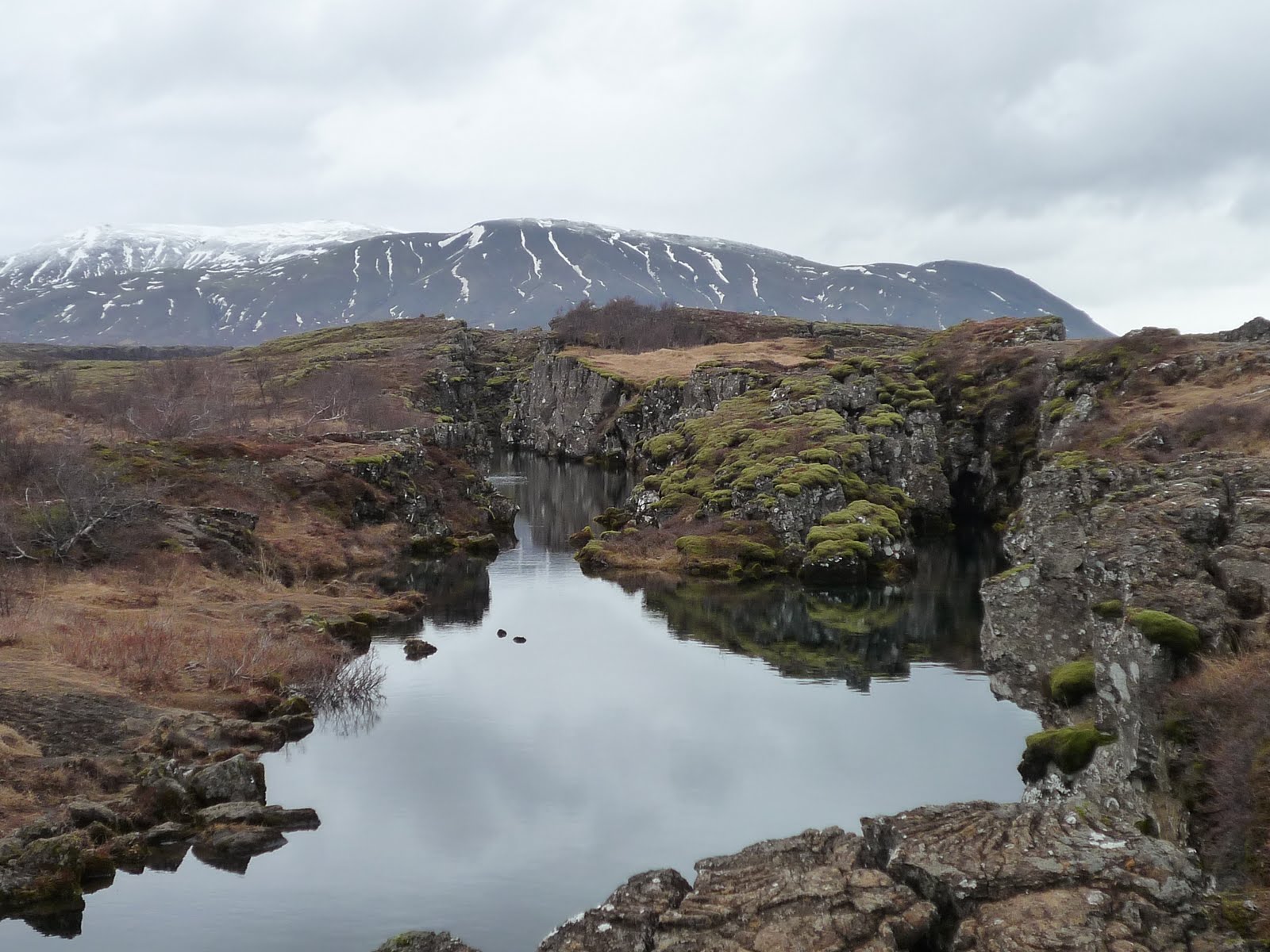


The second reason for Thingvellir's special status is a political one. After settlement, but before the struggles between the chieftains, the early Icelanders needed to decide on a method of government. The so-called Thing, a meeting of community members to decide important issues, had been a Nordic tradition for generations in towns and villages. The Icelanders posed the question, why not have a Thing for all of us? The result was the Althing, one of the world's first (the Icelanders proudly say very first) democratically elected parliaments. When the Althing first met in the early 10th century AD, its members assembled in what is now the Thingvellir National Park. Their specific assembly point was called the Rock of Law, but to me this resembled more of a rocky outcropping than a grand boulder.

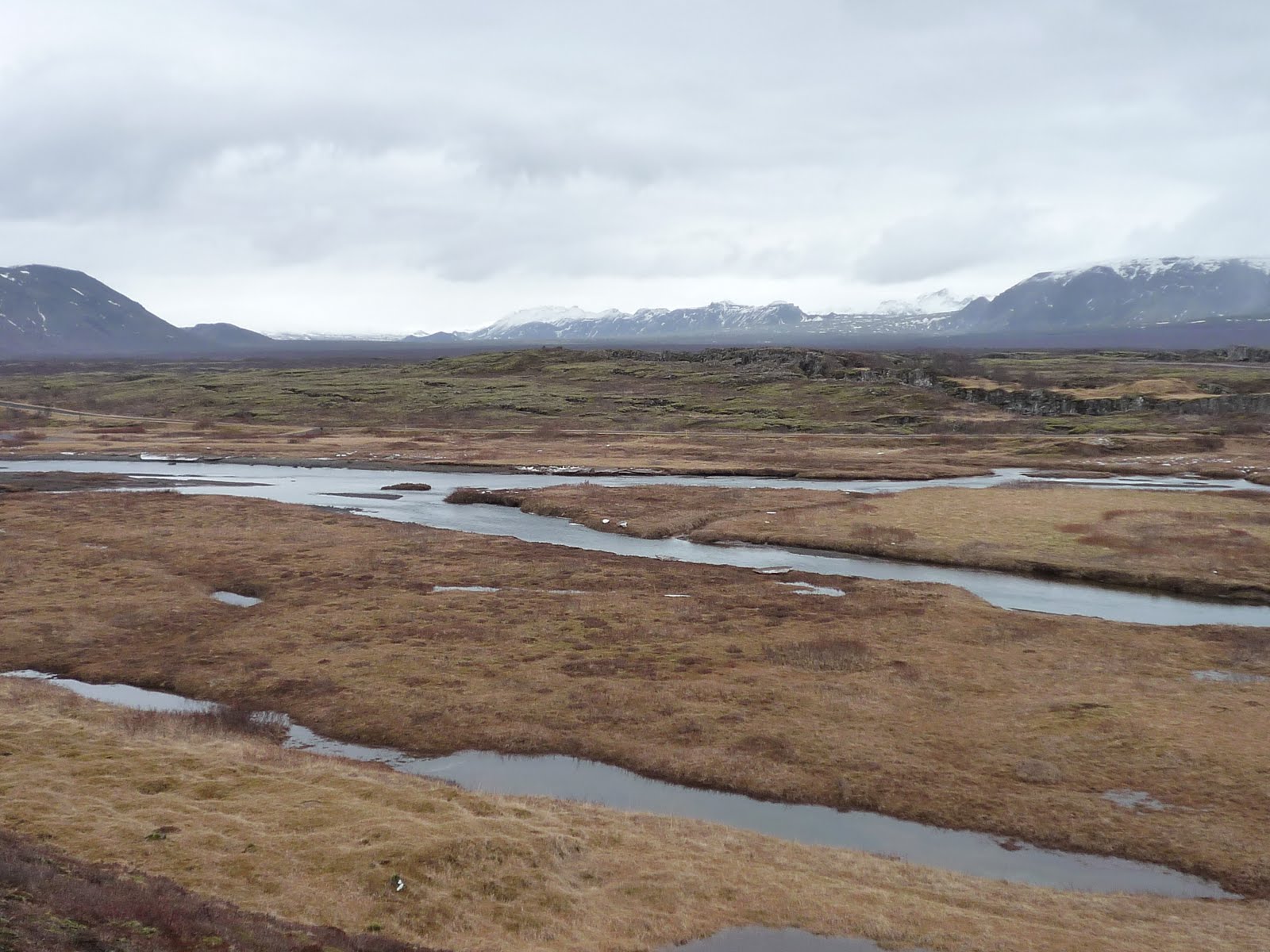
In June of 1944, with Denmark under Nazi occupation, Icelanders again gathered at the Rock of Law to declare their independence, and the modern Republic of Iceland was born. The fledgling state's economy was jump started by America and Britain, who both poured money into constructing military harbors and air fields on Iceland during the Second World War. Iceland's parliament is still called the Althing. In the end, perhaps the parliament doesn't need a grander assembly hall in downtown Reykjavik, it can lay claim to an entire rift valley where nature's humbling might is on display for all. For the next photo, which shows a wider view of Thingvellir, I stood on North America and focused the camera on Europe.


The next day I sampled some of Iceland's edible curiosities, and there were some strange ones. The picture below shows the items I tried. On the left side of the plate is a slice of fresh Icelandic flat bread with spread butter and smoked lamb on top. The lamb is popular in the country and has a surprisingly sweet and delicious taste considering that it is smoked using dried sheep dung. The small bowl in the foreground contains strips of dried fish, on which butter is supposed to be spread. I found the texture like rough leather, and only the butter provided any taste. The yellow open-faced sandwich in the bottom right is made from a slice of rye bread and a portion of fish stew, which wasn't really a stew at all, rather more of potato salad with chunks of fish mixed in. This tasted neither good nor bad, simply bland really, which was surprising because the restaurant I dined in supposedly made some of the best fish stew in Iceland. On the contrary, the orange sandwich in the top right was very tasty. Here I had another slice of rye bread topped with butter, smoked trout, and cottage cheese. Something gave this a bit of sweetness as well. The most challenging item, though, was what lay inside the second bowl on my plate.


In the picture below you can see some small chunks of harkal. How this dish was ever first conceived and why is beyond me, but here is the basic preparation process. A certain species of shark is fished from the sea and brought to land. After being beheaded, the shark's body is placed in a hole in the ground, covered, and left to rot for a few months. It is then taken out of the ground and hung in the open air for several more months. After about nine months in total, the putrefied shark is, naturally, ready to eat.


I started this food challenge with a full glass of water and a clear of understanding of where I could find the restroom. To begin, I sniffed the meat. Not surprisingly, it was unpleasant, but not nearly as bad as I would've expected rotten meat to be. The odor was familiar, but I couldn't place it. Then I brought one of the chunks into my mouth and started to chew, slowly. At first there was no taste, and the meat was tough. The more I chewed, however, the more tender it became and the more that strange aroma filled my mouth. The taste spread over my tongue, onto my inner cheeks, and up to my palate, intensifying as it marched on to conquer my mouth. Flashes of biology class and doing the laundry ran through my mind and I realized that the taste was something akin to the pungent smells of bleach and formaldehyde. First there was a tingle, and then a burning sensation on my tongue. As I finally swallowed the meat, the burning feeling traced its way slightly down my throat before being extinguished. And yet I never once gagged or felt the need to vomit.

After I had finished my portion of the harkal, I asked the cook about it and specifically if it was safe to eat. She said the "fermentation" process, as if I had asked about a wine or beer, also kills off the deadly bacteria; however, sometimes people will complain of feeling dizzy after eating it. I had come to Iceland curious to try this disgusting dish, and now that I have, I can confidently say I will never again desire to.

There were some other foods that I tried in Iceland, but nothing as exotic as the ones above. Skyr was a sweet dairy product that was denser than yogurt but somehow seemed airier. A famous stand in downtown Reykjavik served its budget hot dogs with ketchup, sweet mustard, mayonnaise, and fried and raw onions. The only thing that I really had a problem consuming in Iceland was the tap water because the high sulfur content made it taste like rotten eggs, one disadvantage of the island's geothermal activity. I gagged every time I brushed my teeth.

For my last two days in Iceland I stayed in Reykjavik, walking around the city and visiting some of its museums but none too noteworthy. On March 18th I took an early morning bus to the airport and said goodbye to Iceland.

This has been a long post, perhaps my longest, but my experience in Iceland was so thrilling and memorable for me that I had much to share. I could say more about the places in Reykjavik, the Icelandic people, or the country's history, but I suppose if I've held your interest for this long some of those things would be better discovered on your own visit to the country.

The next post will finish up the account of my Nordic travels with the stories of my time in Norway.

31 March 2010

Christiania: Copenhagen's Dirty Secret

If you have ever wondered what would actually happen if die-hard hippies, anarchists, and other groups of similarly extreme, far-from-the-mainstream political thinkers got their way, then perhaps you should consider a tour through Christiania. I warn you, however, that a visit is not without its dangers.

The so-called "independent" community of Christiania finds itself on an island in Copenhagen's harbor, only a bit east of the city center. This social experiment began in the early 1970s when a group of squatters moved into abandoned military barracks on the island, likely motivated by that politically explosive era. They then proceeded to declare their independence not merely from Copenhagen but Denmark as a whole, and set about to organize an anarchistic society. Though a few rules supposedly existed to ensure the safety of the residents, the founders' intentions were to create a community free of any government or state interference and where an anything-goes mentality was the de facto law of the land. As a result, the lanes and shacks of Christiania soon filled with all characters from fringe society. While some respectable entrepreneurs set up stalls to sell organic produce or hand-made utensils and household items, others took advantage of the booming drug market. All of this retail activity took place openly and without any stigma against it from the Christianians.

From the beginning, the governments of Copenhagen and Denmark took a wait-and-see approach. With their refusal to pay taxes, unauthorized settlement of government property, and other illicit activities, Christianians were definitely leading illegal lives, but the governments were also uncertain of how to deal with the situation. On one hand, Christiania centered Copenhagen's drug market in one neighborhood. Destroying the community would simply disburse the trafficking throughout the city, making it more difficult to police. On the other hand, the governments were essentially granting Christianians immunity from the laws that applied to all other citizens of Denmark. Within the last twenty years or so this relationship of acceptance has changed as the drug trade grew stronger and influenced a rise of violence.

Under increasing pressure from the governments, Christiania entered into talks of more normal integration with the city of Copenhagen. The Christianians remained suspicious of the governments' positions regarding greater access to the community with public utilities and vehicles, points which the governments argued were necessary in order to improve public sanitation and safety. Additionally, though the Christianians had, for their part, tried to reduce the trafficking of hard drugs, their efforts were too little in the eyes of Copenhagen and Denmark. While some progress was made, a climax came in 2004. In that year police raided Christiania in order to crack down on the drug market. Whatever success they had was barely noticeable during my visit.

Reading about Christiania in my guidebook made me curious enough to check it out. I expected to simply find a scruffy neighborhood adorned with innumerable Bob Marley, Che, and other similarly themed decorations. The fact that Christiania didn't appear on the city's official visitor's map told me something about it, but the reality of what I soon saw exceeded my expectations.

I entered Christiania from one of its two entrances. After leaving a nondescript street of Copenhagen, the path took me though a dusty lane and around an overgrown earthen mound and brick wall. Past all of these barriers, out of view from the street, begins the so-called "Pusherstreet," Christiania's main drag. Imagine a scene from a Hollywood movie depicting urban life in some post-Apocalyptic world, throw in a bit of Disneyland, and you start to develop an idea of what Christiania looks like. Colorful stalls and shacks lined Pusherstreet. The number of these rickety shops selling T-shirts seemed as many as those offering varieties of cannabis, the scent of which hung in the air. Paving on Pusherstreet was patchy at best. Litter floated in the rain puddles and festooned the weedy vegetation. The few trash cans available must have been a joke. Every dozen yards stood a steel barrel with a fire burning openly inside of it; dodgy assortments of people huddled around the barrels seeking warmth from the flames. Apparently any material that sparkled, shined, or added bright color was suitable to attach to building walls as art or decoration. The farther down Pusherstreet I strolled, the more my surroundings boasted their counterculture attitude.

At the end of Pusherstreet the path forked. To the right was an opening to what resembled an open air food court that was as decrepit as everything else I had seen. Here stalls sold vegetarian dishes and organic food. A stage rose from one end of the opening, but only a couple thick-bearded men sat on its edge. Back to the fork and to the left, the path led past some more buildings, ones that I can only assume were the original military barracks. An occasionally open front door provided glimpses into dimly lit rooms where I could only distinguish human forms and the glowing red ends of what were likely not mere cigarettes. At a few picnic tables outside of what looked like a bar, a few men sat, conversing in Danish and rolling marijuana joints. A mural on one wall caused me to stop and take notice. It read simply, "Common law of Christiania," and below the text were three depictions: two of clinched fists and one of a gun. Compared to this place, Amsterdam was a playground.

As striking as the physical setting was, so were the people moving about in it. For one thing, I had never seen such a diverse collection of all clean and grimy forms of alternative lifestyles. Most individuals standing around presented a grungy look, dressed in ragged clothes complete with the corresponding symbols of their respective extreme political and social views. Teenagers and young adults dressed themselves in punk outfits and the anarchist uniforms of nearly all black clothing. Older men and women wore colorful hippie clothes. Mixed in with these types were those who appeared homeless, street people in the true sense. And then there were the tourists. They stood out like most of the residents of Christiania would in a suburban shopping mall, and definitely did not go unnoticed by the Christianians. During my entire time in the community I sensed the eyes of the locals were on me. Through their looks they seemed to say that they knew I wasn't one of them, they would prefer for me not to be there, but permitted my presence because I could be a potential customer of their merchandise.

One can't take ten steps in any direction without seeing a hand-painted sign instructing visitors not to take photographs. Christianians will likely say that this rule exists to protect their privacy, which is probably true to an extent; however, I believe the full version is that they don't want any evidence that could link faces with the illegal activities in the community. Here, with this ban on photographs, is where my personal problems in Christiania began. Witnessing such a unique place, I couldn't bare to walk away without some documentation of it, no matter what a bunch of hippies tried to tell me. Of course, I wasn't foolish enough to take out my camera in the middle of Pusherstreet.

After I had seen enough of Christinia I returned to the boundary of the community, whence I had entered. From the last perspective where one could still have a view down Pusherstreet, before rounding the earthen mound, I stopped and looked around. No one seemed to be watching me. No one was close to me. This was my chance.

I reached into my jacket pocket and pulled out my camera. In defiance of a large "No Photos" sign directly facing me, I quickly turned on the camera, zoomed in, and snapped the picture. There was no angry mob, no yells. Feeling ambitious I tried to take a second picture, but in this moment the battery of my camera died. A bit disappointed, I returned the camera to my pocket and walked briskly to the exit, hearing what sounded like, "No photos!"

After the earthen mound I was within thirty feet of the street, almost back to civil society, when a young man looking about my age rode up on my left side on his bike and then abruptly cut off my path.

"Do you speak English?" he asked with a strong Danish accent.

I thought quickly. His reason for being there was clear. Perhaps if I pretended that I didn't speak English well he would become frustrated with trying to talk to me and leave me alone. The strategy usually worked with annoying panhandlers and souvenir-pushers in other European cities; it was worth a try.

"Oh, a little," I said with some fake accent. One advantage of teaching English in Germany is that I've become very familiar with the common grammar and pronunciation mistakes that non-native speakers make. In German, I next asked him if he spoke that language, assuming he didn't. He only stared at me for a second then continued to speak English.

He explained to me that photos weren't allowed in Christiania, and that he had seen me taking some.

"Ah, yes, um...sorry," I responded. "Uh, I go. I go." I stepped to the right and ahead to go around his bike and to the street, but he moved to block my path again. A brick wall and the mound prevented me from moving any farther in that direction. My assessment of the situation suddenly changed.

"No, no, no," said the man. "You have to delete the picture."

I briefly acted like I didn't understand, but that changed nothing. Knowing that I was dealing with a guy who had most likely already made some irrational choices in his life and that dozens of his friends were only a shout away, my better judgment won. A photo wasn't worth risking what he was potentially willing to doing.

Removing the camera from my pocket I held it so that only I could see the screen. I pushed the power switch into the on position, but nothing happened. Only then did I remember that the battery was dead. At first I thought this was good thing; I wouldn't be able to delete the picture. Then my thinking quickly reversed. What would he demand if I couldn't delete the picture?

"Uh," I looked up at the man. "The, the...battery...dead."

"What? No f---ing way. I don't believe you. You're f---ing with me. Give me the camera."

The tension immediately rose. My grip on the camera tightened. In my own firmer tone I told him again that the battery was dead, but he wouldn't believe me.

"Yes!" I extended the camera out slightly so that he could see the screen for himself. "On, off, on, off," I said as I moved the power switch between the two positions. "Nothing."

"No, no," he still refused to believe me. The man then reached his hand out so that he could push the switch himself. I held on to the camera with both hands. He pushed the switch into the on position so hard that for a moment I feared he might break it.

At that instant another voice from my rear announced the arrival of a second man. "Just delete the f---ing photo, man!"

I turned to my left to see this second man dismounting his bike. Now there was no way out. To my back was the wall, to my right the first man blocked my path to the street, the second man blocked my way to the second exit, and the direction to my left led only back to Christiania. I told the second man that the camera was dead, but he was just as incredulous as the first man.

"Yes, it's dead," I insisted. "On, off, on, off, nothing!" I yelled while showing the second man the camera screen, flipping the switch back and forth, and continuing my masquerade of poor English. I didn't know what to anticipate.

As suddenly as the confrontation had worsened, it ended. Both men took steps back.

"You're lucky today, I should take you camera," the first man said as he turned his bike around.

"Ya, learn to respect other people, man," the second man added in the greatest of ironies while following his friend.

I shouted back my own colorful expression in German and walked to the exit. Finally reaching the street, I quickly walked away with some stressed nerves.

In the end, the men were not willing to resort to any more drastic means in regards to the photograph and, in retrospect, it does seem understandable. The police detest Christiania. The government would prefer to raze it, but doesn't know how to proceed. But an attack on or theft from a foreign visitor could have been an excuse for the government to raid the community again. Perhaps these two punks, as damaged as their rationale is, might still have understood that. Then again, as damaged as their rationale is, maybe not.

Violence is certainly not unknown in Christiania. A quick look over the community's page on Wikipedia offers headlines describing shootings, a grenade attack, and riots, all in recent years. A Danish man in my hostel room told me later that night that police officers must enter Christiania in large groups due to safety concerns.

In light of these issues, one would expect the city to do more to warn tourists. Yet the tourists come to gawk at the spectacle that is Christiania. Perhaps for the reason that the community sits in Copenhagen, Denmark, one of the safest areas of already safe Western Europe, visitors have a false sense of security there. I remember seeing a group of three college-aged American girls walking through Christiana, purses balanced on their shoulders, and saying that they should return that night to hang out in one of the bars. I also wonder what would have happened had I honestly not spoken English. I of course understood what the men wanted from me, but other foreigners wouldn't have been so lucky. Indeed, the city should do more to protect the tourists who wander Christiania's lanes with the ignorant illusions of being in a theme park-like atmosphere.

The experience also demonstrated to me the folly and short-sightedness of anarchism. A society that began as a peace-loving and well-intentioned one without laws has degraded to one of low living conditions, drug abuse, threatening methods, and the introduction of rules in order to control visitors who don't think like members of the society and to protect the own good of the locals. I surmise that Christianians can now be grouped into three main categories: the old hippies who likely helped to found the community and who still believe in its original goals but who now number in the minority, the potheads and druggies who only care about their next fix, and the anarchists who have taken over for their own profit and in the name of their political beliefs. Furthermore, not only does a capitalist market flourish in Christiania, but it is also one that offers cheap souvenirs and other junk for tourists. It appears that Christiania is today a society where personal interest, possibly in the form of profit from selling T-shirts or in the form of self-gratification through drugs, and one ideology preside--a stark contrast to the original concentrations on the greater good of the community and individuality.

To conclude, here is the cause for my problem in Christiania and the inspiration for this post, a simple photograph recorded before even coming into focus:


29 March 2010

Nice Copenhagen and Mild Denmark

My trip in the North finished last Wednesday, and since then I've been enjoying the comfort of home. This is the first post of several to come over the next days to better present my recent travels. Unfortunately, I have learned that Blogger.com is currently experiencing technical issues with the display of images on many of their hosted blogs, which means that you likely won't be able to see my photographs for the time being. As of today, though, staff at the organization is working to fix the system-wide problem. In the mean time, try to make due with the text, and check back in a couple days to see if the images are displaying correctly.

As mentioned in my previous posts, my northerly travels began on March 10th in Copenhagen, the capital of Denmark and the largest city in Scandinavia with about 1.2 million residents. The country lies to the north of Germany, which is actually the only nation that Denmark borders on land. Geographically speaking, Denmark consists mainly of the Jutland Peninsula, the mainland portion of the country that stretches out from the German border, and several islands of varying size to the east of Jutland. Of these islands, Zealand is the largest and home to Copenhagen, which itself is so close to Malmo, Sweden that a recent bridge and tunnel project has spanned the Oresund Strait to connect Denmark, and thereby mainland Europe, to Sweden and the rest of Scandinavia. Though an autonomous region, the disproportionately large Greenland remains under the authority of Denmark.

Aside from political meetings and global conventions, Denmark has held little power in the international arena for quite some time, but it wasn't always so. The Danish culture and society as they exist today can trace their origins to the Viking era from around 1000 AD. Like today, the Danes of that time held strong relations to their Scandinavian brethren to the north in present-day Sweden and Norway. With their fellow Scandinavians, the Danes sent out on Viking expeditions to pillage, explore, and settle. One of the many finds from their voyages would be Iceland, but that is a story for another post to come.

By the Middle Ages the Danish crown ruled over all of Scandinavia. With the breakaway of Sweden a series of wars ensued leading to the eventually recognized independence of the other country, but Norway, Iceland, and other islands in the North Atlantic remained a part of Denmark. From this glory age of Scandinavian union, in my opinion, Denmark began its slide into relative obscurity. Over the next centuries, and again from the opinion of someone who is not a professional historian, Denmark seemed to concern itself too much with its local, petty interests. Conflicts with Sweden persisted as Denmark occasionally tried with varying success to win back territory long lost. Additionally, the Danes waged war a few times with the Germans to the south over small bits of water-logged lands called Schleswig and Holstein, disputes which wouldn't be fully resolved until the 20th century. Eventually Denmark lost Norway and Iceland, and became a constitutional monarchy with an elected parliament.

Though numbering less than six million, the Danes continue to push hard to remain involved in international affairs, as the recent climate change summit in Copenhagen can attest. Closer to home, Denmark strives like the other small countries of Europe to have its voice heard among the powerhouse nations of the continent. Though a member of the European Union, Denmark has chosen like Sweden to so far stick with its own currency rather than use the euro. After arriving in the country and seeing price tags, the euro was indeed something that I missed during my travels.

My overnight train pulled into Copenhagen close to noon on Wednesday. After checking in at my hostel I spent the afternoon and evening visiting several of the city's museums, most of which were to my luck free on that day of the week. The first stop was the Royal Danish Arsenal Museum. The exhibit offered an impressive collection of artillery pieces collected from over the centuries, but was otherwise a simple look at various weapons. A view of the artillery hall is below.


The museum was located on Slotsholmen, an island in the middle of the old town that boasts several former royal buildings renovated to house many of the modern government's offices. The bridge in the following photo leads to the island and the Christiansborg Palace, where the Danish parliament meets.


From there I moved on to the National Museum, a superb display of Danish history. The exhibits provided excellent insight into the development of Danish culture from Prehistory through the Viking era and up to the year 2000 with informative displays and actual artifacts. It was here where I learned much of what I now know of Danish history.

When the museum closed at six o'clock, I walked on to another museum but first with a brief stop in the Danish Royal Library. The original brick and mortar building of the library was constructed about 100 years ago, but in 1999 an extension was built across the street and next to the harbor. This modern portion is a sleek and black granite cube that rises from the ground at an angle. A few skybridges connect the extension with the original building. Here's a look inside the atrium of the extension looking toward the harbor.


I soon arrived at the National Art Museum. Though a bit disappointed by the collection and confused by the organization of the pieces, I didn't complain any as the entrance fee was zero Danish krones.


On Thursday, my only full day actually in Copenhagen, I spent time walking the streets of the old town and visiting a couple more sites. The largely pedestrianized old town presented a mix of squares, shops, and classical architectural styles. Perhaps I have only become somewhat jaded from my European travels, but I was not overly impressed by the old town's appearance. Ugly, no, but it lacked that certain charming quality that many other great cities of Europe have delighted me with. Passing a toy store I couldn't resist going inside for only a short look at their assortment of Legos for sale; Denmark is after all the country where these internationally known plastic building blocks originated. A fresh spot in the old town was the colorful Nyhavn canal, a photo of which appears after the view of a public square.


From the canal I continued north along the harbor front. After a little time I reached the Amalienborg Palace complex, the winter home of the Danish royal family. My random arrival coincided with the daily changing of the guard ceremony. A glimpse of this pageantry is below. After the ceremony concluded, a black limousine escorted by a likewise black sedan and a police car rounded a street corner, drove onto the central square and toward the gates of the palace. I should have asked to be certain, but guessing from the excited reaction of picture-taking and hand-waving by the nearby Danes I assumed that the woman in the back of the limousine was a member of the royal family.


From the palace grounds I pushed on northwards along the harbor with a certain destination in mind. I wanted to see one of Copenhagen's best known landmarks, which curiously enough wasn't much of a true landmark at all. On some rocks cropping out from the lapping waters of the harbor rests a forlorn looking statue. The artwork depicts the main character of Danish author Hans Christian Andersen's story, "The Little Mermaid," and the inspiration for the Disney movie. Indeed, the diminutive mermaid could easily go unnoticed by passing tourists expecting something grander.


From the statue I headed back south and to the Museum of Danish Resistance. The displays at this museum tell the tales of Danish resistance against Nazi occupiers during World War II. When Germany attacked in 1940 the initial battle lasted mere hours before Denmark agreed to comply with the invaders. Germany needed Denmark as a jumping off point to reach and occupy Norway, where deep fjords could provide safe harbors and access to the North Atlantic. Over the next few years during the occupation Germany allowed Denmark to maintain self-rule but with control that grew more limited as the war dragged on. As the museum presented it, the Danish resistance seemed less than I would have expected, as mostly non-violent means were used. Unfortunately for the Danes, due to their country's position of low strategic importance from the Allies' perspective, they essentially had to wait for Germany to withdraw before being entirely free again.

From walking around the city I had developed an appetite and knew exactly where to go. Ida Davidsen is local institution in Copenhagen that offers the Danish specialty smorrebrod. The open-faced sandwiches are available from several cafes and restaurants around the city, but Ida Davidsen serves up gourmet versions that even the Danish queen is known to crave. The toppings for a smorrebrod sandwich come in endless possibilities. Simpler styles involve common items like deli meats, cheeses, tomatoes, smoked salmon, and eggs, while fancier ones can include pigeon or smoked eel. Below, photo of an old menu decorating a wall in the restaurant shows the variety. To order, one approaches the glass counter that contains several of the possible colorful selections and picks one. A fresh sandwich is then made for the customer and brought to his table. I chose a version that came with a breaded fillet of a white fish, smoked salmon, black caviar, shrimp, asparagus, and some sweet orange sauce all topping a small slice of rye bread. You can see the delicious sandwich for yourself in the second picture below.


After eating, I headed over to a community in Copenhagen called Christiania, where I had my run-in with a couple anarchistic punks. I will save this story though for a separate post to follow.

On Friday I took a day trip to a couple towns north of Copenhagen in order to visit some castles. The first stop was the city of Hillerod and its Frederiksborg Castle. This Renaissance fortification spreads itself over three islands in a large lake neighboring the city. Here is a view of it from across the water.


With construction on parts of the castle beginning in the 16th century, its walls have since then witnessed the coronation of several figures of Danish royalty. Today the rooms of the castle house the National History Museum, and in most cases are the attraction themselves. As the next two pictures show, the interior of the castle has been beautifully restored and maintained. Keep in mind one of the advantages of traveling in the low season while noticing the absence of other people in the photos.


From Hillerod I traveled to Elsinore (Hellsingor in Danish) and visited Kronborg Castle. Though I arrived too late to see the castle from the inside, I was still able to stroll around its courtyard and along its ramparts in the dreary afternoon. The last photograph shows a view of the courtyard. Kronborg Castle and Elsinore are famous for being the setting used in Shakespeare's Hamlet, in which the memorable line of, "Something is rotten in the state of Denmark," is used. Satisfied with my walk around the castle grounds, I then spent a little time in a cafe before returning to Copenhagen in the evening.


On Saturday morning I checked out from they hostel and rode a train to the airport. From this gateway I would reach the next destination of my trip, Iceland.

In the end, I found Copenhagen a nice city with a rich choice of museums and cultural attractions, but the it did not win me over entirely. It was a good city to visit, but it doesn't leave me with the desire to return. Not that I'd refuse to go back for a second visit, but the first seemed to suffice. "Good, but not more," seemed to be the theme of my stay in Denmark, naturally with some of the exceptions noted above. Of course, my experience in seedy Christiania could have affected my impression of Copenhagen. To find out why, stay tuned for the next post.

22 March 2010

In the Arctic

For the second time in my life I'm north of the Arctic Circle. Last time it was in Finland, this time it's Norway.

I arrived in Oslo last Thursday and only stayed until Saturday, as my urge to go north could not be restrained. After the diminutive capital of Iceland, Reykjavik, Oslo was a bustling metropolis of large museums, boulevards, parks, and monuments. Highlights included such things as Viking ships and Edvard Munch's famous painting, "The Scream," not to mention a visit to a karaoke bar with some fellow travelers staying at my hostel. "Yes," is the answer to your likely question.

I flew to the city of Bodø on Saturday morning, boarded a ferry, and arrived to the village of Stamsund and the Lofoten Islands in the evening. After almost two weeks of travel in the north I've finally encountered snow, layers of it. I asked around in Stamsund and found my way to a hostel, where I met a group of international students who study abroad in Norway and who were taking their own trip. They invited me to the dinner they were preparing and shared their stories with me.

On Sunday I discovered that no buses serve Stamsund on that day of the week, but rather than letting me stay stranded in that fishing village, the group of students offered me a ride in their rented car to the nearest town. After hitching the ride and offering a couple dozen thank-you's I took a bus from Leknes to the town where I currently find myself, Svolvær. Here I have a quaint and dockside private room with a view of the harbor, though a sudden snow storm can quickly turn things grey. Indeed, on the Lofoten Islands the weather can change from blue skies to a howling cascade of snow and back to clear skies all within ten minutes. Calling it unpredicatable only begins to describe the weather here.

I will stay until Tuesday evening, when I will board a ferry back to Bodø and then fly out on Wednesday morning. By that afternoon I should be back home in Eichstaett. The only remaining thing I desire with this trip is to catch a glimpse of the Northern Lights. I missed them in Finland, and hope that this second chance brings better luck.

Once I'm back in Eichstaett I plan to make some extended posts on the stories from this trip and, of course, with photos to help tell the tale.

16 March 2010

Nordic Travels

No, I haven´t already lapsed on my promise to return to frequent posting. Since last Tuesday I´ve been traveling to one of the last corners of Europe that I´ve yet to see: the Far North.

On Tuesday evening I boarded an overnight train to Copenhagen, Denmark. I stayed in the Danish capital for three days, enjoying the several cultural institutions of that city. I visited an impressive national history museum with excellent exhibits on Danish culture, from prehistoric times through the Viking era to the year 2000. The Little Mermaid statue on the harbor, which pays tribute to Danish author Hans Christensen Andersen, looked small and lonely. A gourmet Danish smorrebod sandwich left my mouth watering for more. Two grand castles north of Copenhagen brought me back to Medieval times. One of them, the castle of Elsinore, was the setting in Shakespeare´s play "Hamlet." Indeed, the only bad experience I had in Copenhagen was in the so-called, "independent" community of Christinia, where a couple of anarchist punks were displeased with me taking pictures. That is one story which I will tell in detail once I´m back home and have the time to properly do so.

By the Far North though I of course did not just mean Denmark. On Saturday a plane took me from Copenhagen to the northern-most capital in the world: Reykjavik. Iceland is a beautiful country, and the prospect of paying it a visit excited more that many other destinations have recently. The land of fire and ice has not dissapointed me.

I spent most of Sunday at the famous Blue Lagoon spa and thermal springs. Imagine eerily blue and steaming pools of water surrounded by an otherwordly landscape of hardened lava fields, this is the Blue Lagoon. To soak in its warm waters is a soothing experience. Expect coloful photographs to come.

Yesterday I toured some of the inland parts of this country. Sights included a geothermal power plant, a dormant volcano´s caldera, bubbling field of hot springs and geysers, massive waterfalls, and the fault line where Europe and North America geologically meet.

Today I tried some of Icelandic food specialities, and this country does offer some unique ones. Some examples are dried fish with butter spread over it and lamb smoked over fires that use sheep dung as fuel. Believe it or not, the smoked lamb was delicious. And then there was the truly unique dish. Called harkal in Icelandic, it is shark meat that has been left to rot for about nine months under the ground. This putrified fish starts out fine in your mouth, then a taste of bleach starts develop and fills your palate until your mouth starts to burn. Definitely not for those with weak stomaches. The waitress assured me that there were no harmful bacteria, though sometimes people complain of diziness.

Photographs and more stories will be posted in near future.